
The Conservative Cage
How Decades of Republican Federalism Built the Bars That Now Contain Trump

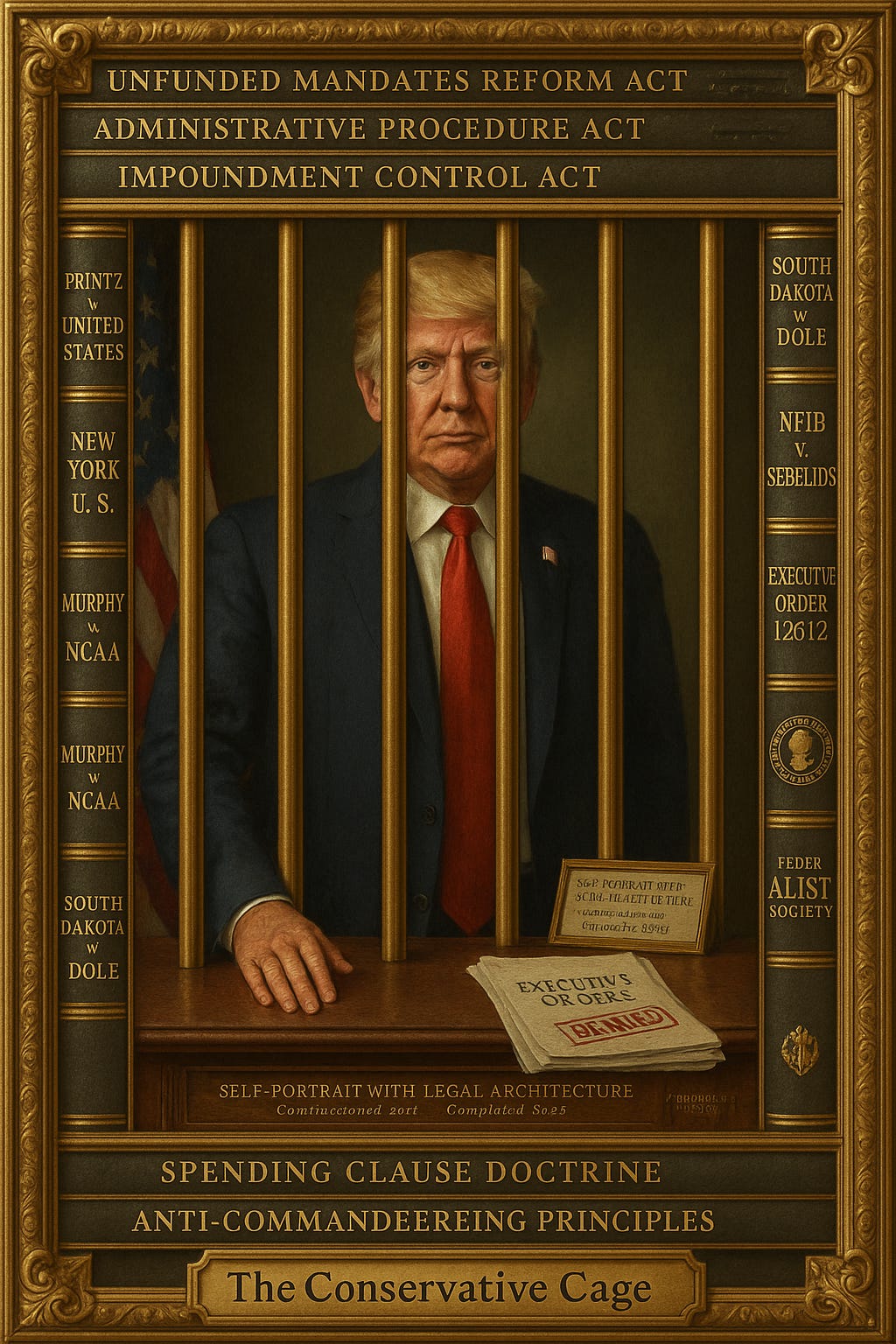
Image created with: ChatGPT 4o
In July 2025, the Trump administration froze $6.8 billion in congressionally appropriated education funding.[^1] Twenty-four states immediately sued.
Their legal argument? The Impoundment Control Act of 1974 and the Constitution’s Spending Clause prohibit the president from unilaterally withholding funds Congress has approved.
The courts sided with the states.
A month earlier, Trump revoked California’s Clean Air Act waiver (authority the EPA had granted California 75+ times under both Republican and Democratic administrations).[^2] California and ten other states sued, alleging violations of “constitutional principles of federalism and separation of powers.”
In 2025, a federal judge dismissed Trump’s lawsuit against Illinois sanctuary policies, ruling the administration “lacks standing” and calling it “an effort to encroach on state sovereignty.”[^3]
These aren’t isolated defeats. They’re a pattern.
Every time Trump tries to force states to comply with federal directives (on immigration, environmental policy, education funding) he runs into the same wall. Federal courts, citing decades of precedent, tell him no.
Here’s the irony: That wall was built by Republicans.
The legal architecture blocking Trump’s executive overreach wasn’t constructed by progressives or Democrats. It was deliberately assembled over forty years by conservative presidents, Republican Congresses, and originalist Supreme Court justices. The same institutions Trump claims to represent.
Reagan signed executive orders limiting federal power over states. The Republican Congress passed legislation constraining federal mandates. Conservative Supreme Court majorities established the “anti-commandeering doctrine” that prevents the federal government from forcing state action.
The Federalist Society (the organization that vetted Trump’s judicial nominees) trained those judges in the very federalism principles they’re now using to block him.[^4]
The conservative movement spent decades building a cage to contain federal power. They just didn’t expect their own leader to be the one locked inside.
The Foundations: Reagan, Republican Congress, and the Federalism Revival
To understand why Trump keeps losing in court, you have to go back to October 26, 1987, when Ronald Reagan signed Executive Order 12612 on federalism.[^5]
The order wasn’t symbolic. It directed executive departments to “refrain, to the maximum extent possible, from establishing uniform, national standards for programs and, when possible, defer to the states to establish standards.”
It articulated nine fundamental federalism principles to guide agencies. It quoted Thomas Jefferson calling states “the most competent administrations for our domestic concerns and the surest bulwarks against anti-republican tendencies.”
Reagan’s order established a philosophy: federal restraint, state sovereignty, deference where possible.
Eight years later, the Republican Congress (fresh off their Contract with America victory) made that philosophy law. On January 4, 1995, Senator Dirk Kempthorne (R-Idaho) introduced S.1, the Unfunded Mandates Reform Act. The bill passed the Senate 86-10 on January 27 and was signed by President Clinton on March 22, 1995.[^6]
The Act’s purpose was explicit: “to strengthen the partnership between the Federal Government and State, local, and tribal governments” and “to end the imposition of Federal mandates on State, local, and tribal governments without adequate Federal funding.”
State and local advocates viewed unfunded federal mandates as “inconsistent with the traditional view of American federalism, which was based on cooperation, not compulsion.” The Republican-led Congress agreed. They made it federal law.
Even Clinton, facing pressure after trying to replace Reagan’s executive order in 1998, eventually issued Executive Order 13132 in 1999.[^7] A bipartisan continuation of federalism principles requiring agencies to assess federalism implications and prepare impact statements for rules affecting states.
These weren’t just policy preferences. They were building blocks of an institutional system.
The executive orders created administrative culture. The legislation created procedural barriers. And the Supreme Court (with Reagan and Bush appointees forming consistent conservative majorities) started building constitutional walls.
In South Dakota v. Dole (1987), the Court established a five-point test for when Congress can condition federal grants.[^8] The key limitation: financial inducements cannot be “so coercive as to pass the point at which pressure turns into compulsion.”
That test would be cited 33 years later to block Trump’s sanctuary city funding threats.
Each component reinforced the others. Reagan’s executive philosophy became Republican legislative action, which became judicial precedent, which became institutional culture.
The system created feedback loops: federalism principles create legal barriers, barriers protect states, states defend barriers, principles become entrenched.
The result? An institutional system with emergent properties. Constraints on federal power that became more durable than any individual president’s will.
The Architecture: Supreme Court Builds the Anti-Commandeering Doctrine
The constitutional foundation was always there. The Tenth Amendment reserves to the states powers not delegated to the federal government. Article I enumerates Congress’s powers (a list that is, by definition, limited).
But those principles needed interpretation. And between 1992 and 2018, conservative Supreme Court majorities interpreted them into a doctrine that would prove nearly impossible for Trump to overcome.
New York v. United States (1992) was the foundation.[^9]
The Low-Level Radioactive Waste Policy Amendments Act required states to either regulate waste disposal according to federal standards or take ownership of the waste. Justice Sandra Day O’Connor, writing for a 6-3 majority, struck down the “take title” provision as unconstitutionally “commandeering” state governments.
The reasoning was fundamental: “The Federal Government may not compel the States to enact or administer a federal regulatory program.” Congress could not “simply commandeer the legislative processes of the States by directly compelling them to enact and enforce a federal regulatory program.”
Why? Because the Constitution divides authority between federal and state governments. Commandeering breaks that division.
It forces states to implement federal policy, blurring political accountability and shifting regulatory costs. If voters don’t like a policy, who do they blame? The federal government that ordered it or the state government that implemented it?
The structure matters. As the Court explained, the decision to withhold from Congress the power to issue orders directly to states is “a fundamental structural decision incorporated into the Constitution.”
Printz v. United States (1997) extended the principle.[^10]
The Brady Handgun Violence Prevention Act required local sheriffs to conduct background checks on gun purchasers. Justice Antonin Scalia, writing for a 5-4 majority, struck it down.
If Congress can’t commandeer state legislatures, Scalia reasoned, it certainly can’t “circumvent” that prohibition by “conscripting the State’s officers directly.”
The holding was unambiguous: “The Federal Government may neither issue directives requiring the States to address particular problems, nor command the States’ officers, or those of their political subdivisions, to administer or enforce a federal regulatory program.”
This wasn’t about guns. It was about structure. About the division of sovereignty. About limits on federal power.
NFIB v. Sebelius (2012) applied the principle to the Affordable Care Act.[^11]
Chief Justice John Roberts, writing for a fractured Court, rejected the government’s argument that the Commerce Clause authorized Congress to mandate individuals purchase health insurance.
“Construing the Commerce Clause to permit Congress to regulate individuals precisely because they are doing nothing,” Roberts wrote, “would open a new and potentially vast domain to congressional authority.”
The Court also struck down the ACA’s Medicaid expansion as unconstitutionally coercive. While Congress could condition grants on state action (South Dakota v. Dole), threatening to withhold existing Medicaid funds unless states expanded the program crossed the line from pressure to compulsion.
Roberts upheld the individual mandate as a tax, saving the ACA. But he also reinforced limits on federal power: the Commerce Clause has boundaries, and the Spending Clause can’t be used to coerce states.
Murphy v. NCAA (2018) brought the doctrine into the modern era.[^12]
The Professional and Amateur Sports Protection Act (PASPA) prohibited states from authorizing sports gambling. New Jersey wanted to legalize it. Justice Samuel Alito, writing for a 6-3 majority, struck down PASPA as commandeering.
PASPA didn’t require states to ban sports gambling. It just prohibited them from authorizing it. But that distinction didn’t matter.
“The anticommandeering doctrine,” Alito wrote, “may sound arcane, but it is simply the expression of a fundamental structural decision incorporated into the Constitution, i.e., the decision to withhold from Congress the power to issue orders directly to the States.”
The Court offered three justifications: (1) protecting liberty by ensuring a “healthy balance of power” between federal and state governments; (2) promoting political accountability by avoiding blurred responsibility; (3) preventing Congress from shifting regulatory costs to states.
The pattern across these cases is clear. Each decision breaks the constitutional question down to first principles: What does the Tenth Amendment say? What does Article I’s enumeration of powers mean? What is the structural relationship between federal and state governments?
And each time, the answer is the same. The federal government’s powers are limited. States retain sovereignty. Congress cannot commandeer.
Conservative majorities built this architecture. Case by case, precedent by precedent, they constructed walls around federal authority.
Those walls are now holding against Trump.
The Cage Closes: Trump Meets the Doctrine
The pattern is unmistakable. Every Trump administration attempt to force state compliance maps onto a Republican-established precedent that blocks it.
Sanctuary Cities (2017-2025)
In February 2017, Trump issued an executive order threatening to block federal funds from “sanctuary jurisdictions” that limited cooperation with federal immigration enforcement. Santa Clara County sued. On April 25, 2017, Judge William Orrick issued a nationwide injunction.[^13]
The legal reasoning? The order violated separation of powers and the Constitution’s Spending Clause. Only Congress has the power to impose conditions on federal grants. And the conditions must meet the South Dakota v. Dole test. Which Trump’s order failed.
A divided Ninth Circuit panel agreed, finding the order “violated the constitutional principle of the separation of powers and the Constitution’s Spending Clause.”
In Trump’s second term, the pattern repeated. A U.S. federal judge dismissed the administration’s lawsuit against Illinois sanctuary policies. U.S. District Judge Lindsay Jenkins ruled the government “lacks standing” and called the lawsuit “an effort to encroach on state sovereignty.”[^14]
The Ninth Circuit upheld California’s SB 54 sanctuary law in 2019, holding that “California has the right, pursuant to the anticommandeering rule [derived from the Tenth Amendment], to refrain from assisting with federal efforts.”[^15] The Supreme Court declined to hear the government’s appeal.
The precedent blocking Trump? Printz v. United States. The same 1997 Scalia opinion that said the federal government can’t conscript state officers to enforce federal programs.
Sanctuary cities are the mirror image: states declining to conscript their own officers for federal purposes.
Both reflect the same principle. The federal government can’t commandeer.
DACA (2017-2020)
In 2017, Trump moved to terminate DACA (Deferred Action for Childhood Arrivals), the Obama-era program protecting certain undocumented immigrants brought to the U.S. as children.
In June 2020, the Supreme Court blocked the termination in a 5-4 ruling.[^16] Chief Justice Roberts, writing for the majority, found the administration’s termination “arbitrary and capricious” in violation of the Administrative Procedure Act.
The Administrative Procedure Act, enacted in 1946, requires federal agencies to follow proper rulemaking procedures. Courts can throw out agency actions that are “arbitrary and capricious.” Meaning agencies must articulate why they’re changing policy and consider the reliance interests affected.
Trump’s DHS didn’t do that. They failed to consider the reliance interests of DACA recipients and didn’t adequately explain the policy change. The Court sent it back.
The APA wasn’t passed by Republicans. But it represents bipartisan acceptance of constraints on executive power. And it has repeatedly blocked Trump’s attempts to change policies without proper process (including his travel ban, his attempt to add a citizenship question to the Census, and his DACA termination).
As NBC News put it: “This obscure law is one reason Trump’s agenda keeps losing in court.”[^17]
California Clean Air Act Waiver (2019, 2025)
The Clean Air Act includes a unique provision allowing California to set stricter vehicle emission standards than federal requirements. The EPA has granted California 75+ waivers under both Republican and Democratic administrations since 1970.[^18]
In 2019, Trump revoked California’s waiver for its Advanced Clean Cars program. California and 22 states sued.
In June 2025, Trump used the Congressional Review Act to revoke three Biden-era waivers covering California’s regulations phasing out gas-powered cars and trucks. California and ten states immediately sued, alleging violations of “constitutional principles of federalism and separation of powers.”[^19]
The legal question is whether Congress can use the CRA to overturn EPA waivers (something it has never done before). Both the Senate parliamentarian and the Government Accountability Office have said EPA waivers aren’t subject to the CRA.
But the broader issue is federalism. California has had special authority under the Clean Air Act for over 50 years. Revoking that authority without proper justification violates administrative law and upsets the federal-state balance.
Education Funding (2025)
In July 2025, Trump froze over $6 billion in education funding. Twenty-four states sued, invoking the Impoundment Control Act of 1974.[^20]
The Act was passed after Watergate to prevent presidents from unilaterally refusing to spend funds appropriated by Congress. It requires congressional approval for impoundments.
Trump didn’t follow that process. The lawsuit argues he violated the Act and the Spending Clause.
The precedent? South Dakota v. Dole’s principle that Congress, not the president, controls spending conditions. And decades of separation-of-powers doctrine limiting executive authority.
COVID-19 Pandemic (2020)
On April 13, 2020, Trump claimed he had “total” authority to order states to reopen their economies during the pandemic. “When somebody’s President of the United States, the authority is total,” he said.[^21]
Legal scholars immediately corrected him. The authority to protect public health through shutdowns and shelter-in-place orders lies with governors, not the president.
Trump backed down two days later, releasing guidelines for states to follow voluntarily.
Governors exercised independent authority throughout the pandemic (on mask mandates, reopening decisions, and school policies) despite federal pressure. The federalism structure prevented Trump from commandeering state public health authority.
The Pattern
Reagan wouldn’t commandeer states on gun background checks. Trump can’t commandeer them on immigration.
The Republican Congress passed laws limiting federal mandates. Trump can’t ignore those laws to impose his own.
Conservative judges were trained in originalism and federalism. Trump’s executive maximalism violates those principles.
The structure is identical across policy domains. Trump tries to exert federal power. States invoke anti-commandeering or Spending Clause limits. Courts cite Republican-established precedents. Trump loses.
It’s not coincidence. It’s the system working as designed.
The Architects Apply Their Own Blueprints
The irony compounds when you look at who’s blocking Trump: his own judges.
Twenty-five of the 30 appeals court judges Trump appointed are Federalist Society members.[^22] All six Republican-appointed Supreme Court justices are affiliated with the Federalist Society. Leonard Leo, the Society’s executive vice president, personally drafted lists of acceptable nominees for Trump’s three Supreme Court picks.
The Federalist Society was founded in 1982 to promote originalism, textualism, and federalism in constitutional interpretation. Its members are trained in the legal philosophy that the Constitution means what it says, that federal powers are limited and enumerated, and that state sovereignty matters.
Those principles now constrain Trump.
GOP-appointed judges have repeatedly blocked Trump’s sanctuary city policies on federalism grounds.[^23] Multiple courts run by Republican appointees found his funding threats violated the Spending Clause and anti-commandeering doctrine.
A GOP-appointed judge ruled Trump administration conditions on federal funding were “unlawful,” calling the approach “a ham-handed attempt to bully the states.”[^24]
As The Hill observed in 2018, Trump’s sanctuary city policies have been “repeatedly struck down by both Republican and Democratic-appointed federal judges,” indicating a “growing bipartisan judicial consensus” on federalism principles.[^25]
Chief Justice Roberts (appointed by George W. Bush, a Federalist Society ally) blocked Trump’s DACA termination and limited the Commerce Clause in NFIB v. Sebelius. Justice Gorsuch (Trump’s first Supreme Court pick) has been one of the Court’s strongest voices for limiting federal power.
The architects are applying their own blueprints. The judges Trump picked, trained in the legal philosophy the conservative movement developed, are using that philosophy to constrain him.
Trump wanted judges who would be “loyal.” What he got were judges loyal to principles. Principles that happen to limit executive power.
The poetic justice is almost too perfect. Trump outsourced judicial selection to the Federalist Society. The Federalist Society gave him originalists who take the Tenth Amendment seriously. Those originalists now cite Printz and Murphy and South Dakota v. Dole to tell him no.
He built his own cage.
Institutions Hold, For Now
The conservative legal infrastructure has proven more durable than Trump’s will to power. Not because the judges are personally opposed to Trump, but because they’re committed to a constitutional philosophy that predates him. One that happens to constrain concentrated executive authority.
The cage holds because it was built by true believers. Reagan genuinely wanted to limit federal power. The Republican Congress that passed the Unfunded Mandates Act genuinely believed in state sovereignty. The Federalist Society genuinely trains judges in originalist principles of limited government.
Those principles are now doing what they were designed to do: preventing federal overreach.
But Trump represents something different. Not a belief in limited federal government (that’s rhetoric). His actual governance philosophy is executive power maximalism. He doesn’t want states’ rights. He wants compliance. He doesn’t want federalism. He wants command.
The tension this creates is revealing. What happens to a conservative movement when its leader rejects its foundational principles?
So far, the institutions are holding. Courts cite precedent. Judges apply principles. States invoke their sovereignty. The system constrains the president.
But the guardrails are being tested. Trump’s second term has seen aggressive challenges to decades of settled federalism (revoking California’s waivers, freezing education funds, suing sanctuary states). Each attempt tests the boundaries. Each loss clarifies the limits. But each attempt also reveals the tension between Trump’s model of governance and the conservative legal framework.
The consequentialist chain runs forward: If these principles held against Trump, then what? If Republican judges continue applying anti-commandeering doctrine against Republican presidents, what does that mean for the party? If Trump’s executive maximalism becomes the norm, will future GOP presidents learn from Reagan’s restraint or Trump’s aggression?
The irony is this: The conservative movement spent forty years building legal architecture to constrain federal power because they feared what a president might do with unchecked authority. They feared overreach. They feared commandeering. They feared the accumulation of power in Washington.
And then their own leader became the threat they’d been preparing for.
The cage holds. For now.
The walls are strong. Reagan’s executive orders, the Republican Congress’s legislation, Scalia’s and O’Connor’s and Roberts’s precedents. Trump keeps hitting them and bouncing back.
But here’s the question the conservative movement now faces: Was the cage built to contain federal power in general, or just federal power wielded by the other side?
Trump is testing the answer. And so far, the principles are holding. Even against the party that built them.
That might be the most important thing the conservative legal movement ever accomplished: creating constraints that bind even their own.
---
*The views expressed in this article are those of the author and do not necessarily reflect those of any institution.*
---
Citations
[^1]: NPR, “[24 states sue Trump administration to unfreeze more than $6 billion in education grants](https://www.npr.org/2025/07/14/nx-s1-5467251/trump-school-education-grants-lawsuit),” July 14, 2025.
[^2]: California Air Resources Board, “[California Waiver Background](https://ww2.arb.ca.gov/sites/default/files/2019-09/California-Waiver-Background-Legal-091719A.pdf),” 2019; California Department of Justice press release, June 12, 2025.
[^3]: NBC News, “[Federal judge dismisses Trump administration’s lawsuit against Chicago over its sanctuary city policies](https://www.nbcnews.com/politics/trump-administration/federal-judge-dismisses-trump-administrations-lawsuit-chicago-sanctuar-rcna221197),” 2025.
[^4]: Harvard Gazette, “[How the Federalist Society came to dominate the Supreme Court](https://news.harvard.edu/gazette/story/2021/03/in-audiobook-takeover-noah-feldman-lidia-jean-kott-explore-how-federalist-society-captured-supreme-court/),” March 2021.
[^5]: Ronald Reagan Library, “[Executive Order 12612—Federalism](https://www.reaganlibrary.gov/archives/speech/executive-order-12612-federalism),” October 26, 1987.
[^6]: Congress.gov, “[S.1 - Unfunded Mandates Reform Act of 1995](https://www.congress.gov/bill/104th-congress/senate-bill/1),” signed March 22, 1995.
[^7]: Administrative Conference of the United States, “[Executive Order 13132—Federalism](https://www.acus.gov/appendix/executive-order-13132-federalism),” August 4, 1999.
[^8]: [South Dakota v. Dole, 483 U.S. 203 (1987)](https://supreme.justia.com/cases/federal/us/483/203/).
[^9]: [New York v. United States, 505 U.S. 144 (1992)](https://constitution.congress.gov/browse/essay/amdt10-4-2/ALDE_00013627/).
[^10]: [Printz v. United States, 521 U.S. 898 (1997)](https://www.law.cornell.edu/constitution-conan/amendment-10/anti-commandeering-doctrine).
[^11]: [National Federation of Independent Business v. Sebelius, 567 U.S. 519 (2012)](https://www.law.cornell.edu/supremecourt/text/11-393).
[^12]: [Murphy v. NCAA, 138 S. Ct. 1461 (2018)](https://en.wikipedia.org/wiki/Murphy_v._National_Collegiate_Athletic_Association).
[^13]: County of Santa Clara, “[Federal Court Blocks Trump Administration Withholding Funds from Sanctuary Jurisdictions](https://news.santaclaracounty.gov/federal-court-blocks-trump-administration-withholding-funds-sanctuary-jurisdictions),” April 25, 2017.
[^14]: NBC News, “[Federal judge dismisses Trump administration’s lawsuit against Chicago](https://www.nbcnews.com/politics/trump-administration/federal-judge-dismisses-trump-administrations-lawsuit-chicago-sanctuar-rcna221197),” 2025.
[^15]: [United States v. California, 9th Circuit](https://law.justia.com/cases/federal/appellate-courts/ca9/18-16496/18-16496-2019-04-18.html), April 18, 2019.
[^16]: NPR, “[Supreme Court Upholds DACA In Blow To Trump Administration](https://www.npr.org/2020/06/18/829858289/supreme-court-upholds-daca-in-blow-to-trump-administration),” June 18, 2020.
[^17]: NBC News, “[This obscure law is one reason Trump’s agenda keeps losing in court](https://www.nbcnews.com/politics/donald-trump/trump-losing-court-boring-reason-adminitrative-procedure-act-rcna191113),” 2025.
[^18]: California Air Resources Board, “[California Waiver Background](https://ww2.arb.ca.gov/sites/default/files/2019-09/California-Waiver-Background-Legal-091719A.pdf),” documenting 75+ EPA waivers since 1970.
[^19]: California Attorney General, “[California Will Not Waiver: Defending Itself from Federal Overreach](https://oag.ca.gov/news/press-releases/california-will-not-waver-defending-itself-federal-overreach-attorney-general),” June 12, 2025.
[^20]: NPR, “[24 states sue Trump administration over education funding](https://www.npr.org/2025/07/14/nx-s1-5467251/trump-school-education-grants-lawsuit),” July 14, 2025.
[^21]: Brookings Institution, “[Trump or governors: Who’s the boss?](https://www.brookings.edu/articles/trump-or-governors-whos-the-boss/),” April 2020.
[^22]: Harvard Gazette, “[How the Federalist Society came to dominate the Supreme Court](https://news.harvard.edu/gazette/story/2021/03/in-audiobook-takeover-noah-feldman-lidia-jean-kott-explore-how-federalist-society-captured-supreme-court/),” March 2021.
[^23]: The Hill, “[Fight over sanctuary cities is also a fight over federalism](https://thehill.com/opinion/immigration/381998-fight-over-sanctuary-cities-is-also-a-fight-over-federalism/),” 2018.
[^24]: Newsweek, “[GOP-appointed judge accuses Trump admin of requiring ‘unlawful’ conditions](https://www.newsweek.com/donald-trump-court-fema-funding-immigration-dhs-10878190),” 2025.
[^25]: The Hill, “[Fight over sanctuary cities is also a fight over federalism](https://thehill.com/opinion/immigration/381998-fight-over-sanctuary-cities-is-also-a-fight-over-federalism/),” 2018.