
The Commodification of Uncertainty
The whole deal -- the whole American deal, the whole rigged, broken, blood-soaked deal -- is eating itself alive on a screen you can hold in one hand.

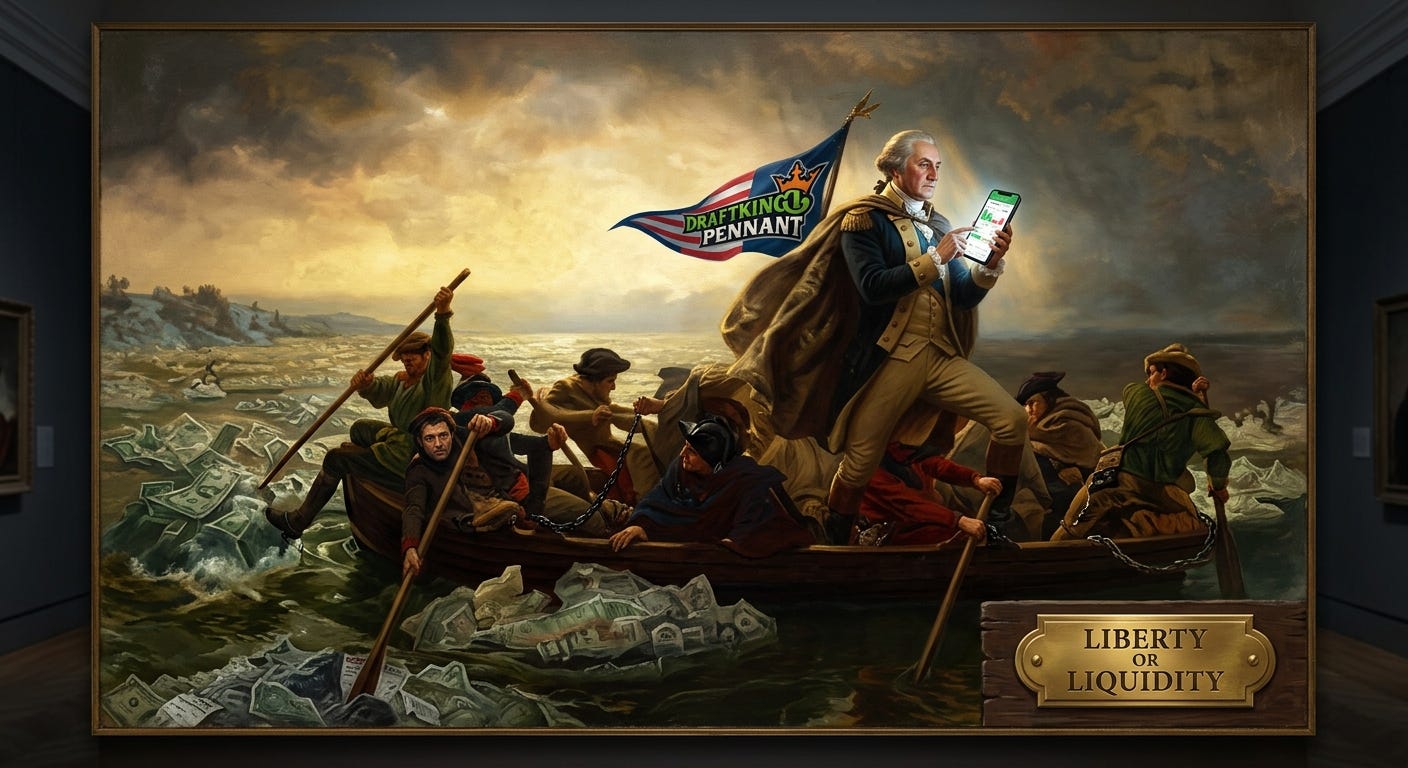
"Gambling could be at the heart of every possible evil. It is the child of avarice, the brother of inequity, and the father of mischief."
- George Washington, who owned human beings
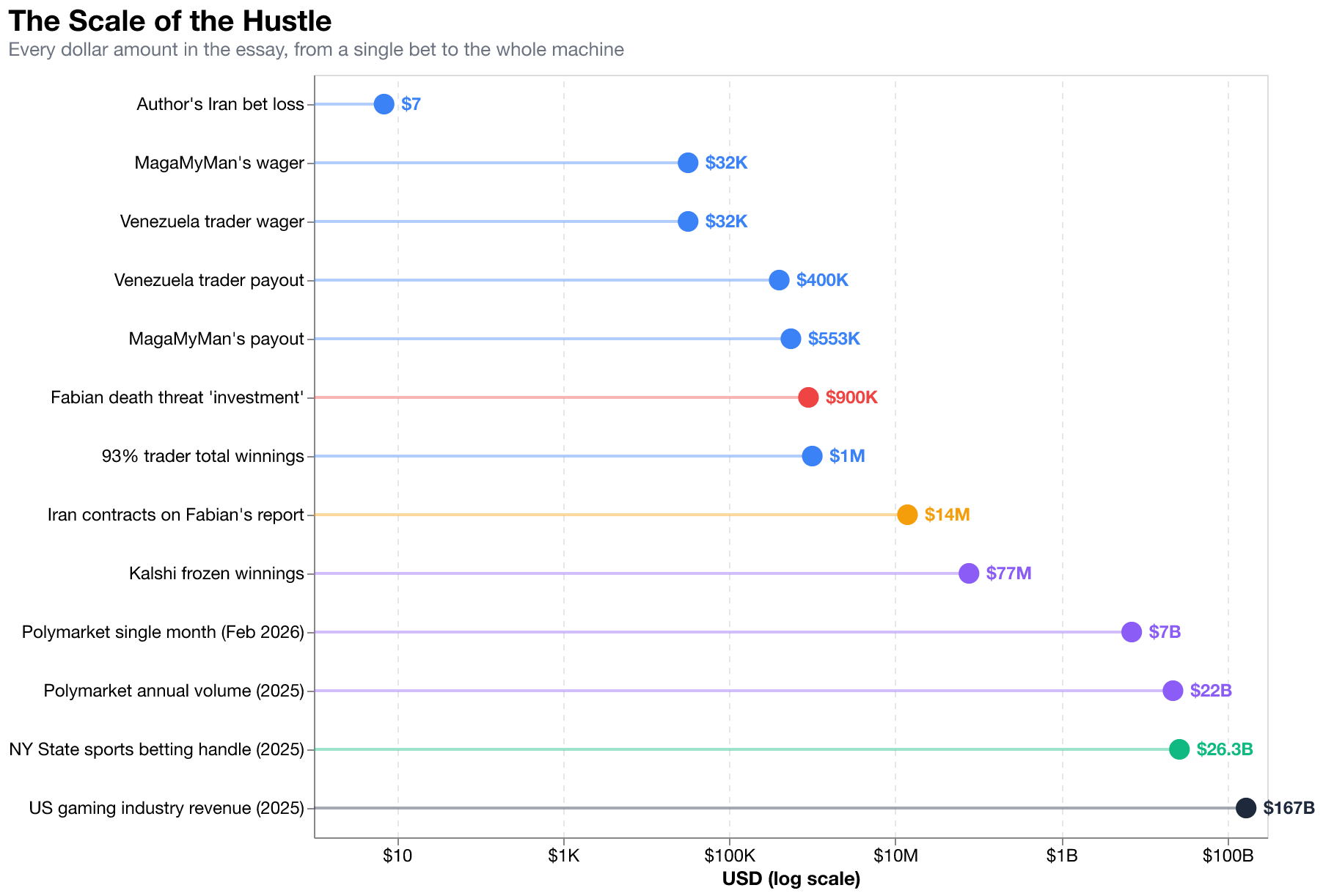
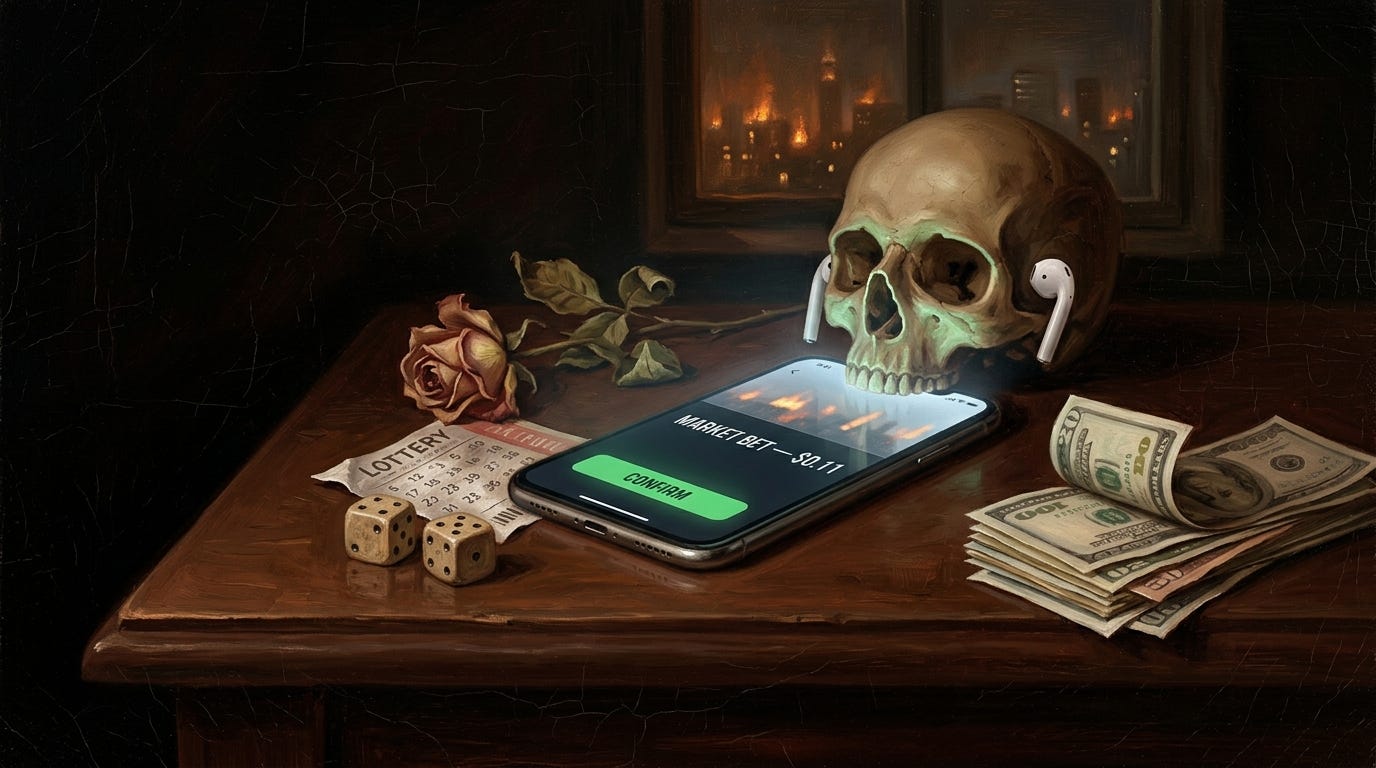
I bought a prediction market contract on a Tuesday night in February. Iran military action by end of month, eleven cents on the dollar. I sat there with my thumb on the confirm button for about forty-five seconds and felt something I was not prepared to feel, which was the precise physical sensation of understanding -- not intellectually, in my body -- why a twenty-three-year-old would build his entire emotional architecture around a screen this size.
It felt like knowing something. It felt like being ahead of the stupid, lumbering, bought-and-paid-for world. It felt like power.
I closed the position the next morning at a loss. Seven dollars. The cheapest education of my life, and I'd be lying if I said I wasn't tempted to open another one.
I. The Oldest Hustle in America
I went looking for how we got here -- the origin story, the hinge where the hustle went legitimate -- and I found it in Harlem in the 1920s, which is where America keeps most of its original sins, filed alphabetically under "things we did and then pretended never happened."
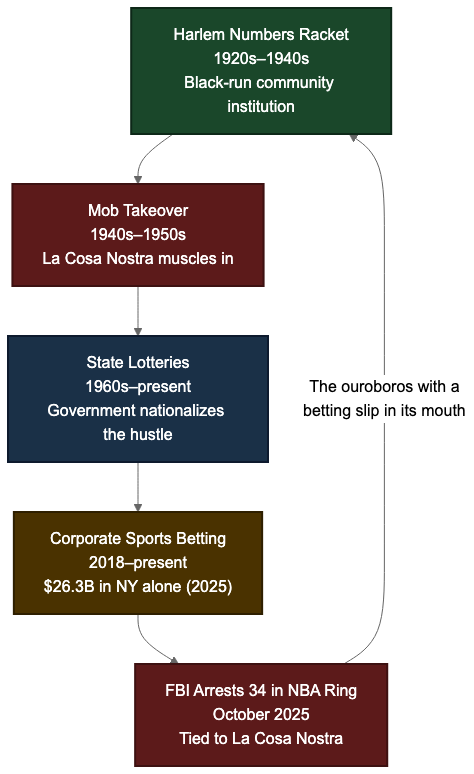
The numbers racket was, by every honest account, the biggest Black-run business in America. Numbers bankers funded Black newspapers, supported Black political organizations, employed Black runners and collectors and accountants in neighborhoods where the legitimate economy wanted nothing to do with them. Stephanie St. Clair -- Queenie, they called her -- ran an operation that was simultaneously a vice, a community bank, an employer of last resort, and the closest thing to a Black economic institution that Harlem had. The game was simple: pick a number, place a bet, see if you hit. The odds were terrible. The profits stayed in the neighborhood.¹²
Then the cops came. Not because gambling was immoral -- the cops knew it wasn't immoral, half of them were on the take -- but because the wrong people were making money. White organized crime muscled in through the forties and fifties. La Cosa Nostra took over the numbers that Black operators had built. And then the state arrived with the final move: government-run lotteries, purpose-built to capture the revenue from the illegal games that had sustained Black communities for decades.
The state didn't eliminate gambling. The state nationalized the hustle. And once nationalized, the hustle did what every nationalized industry does in America -- it scaled.
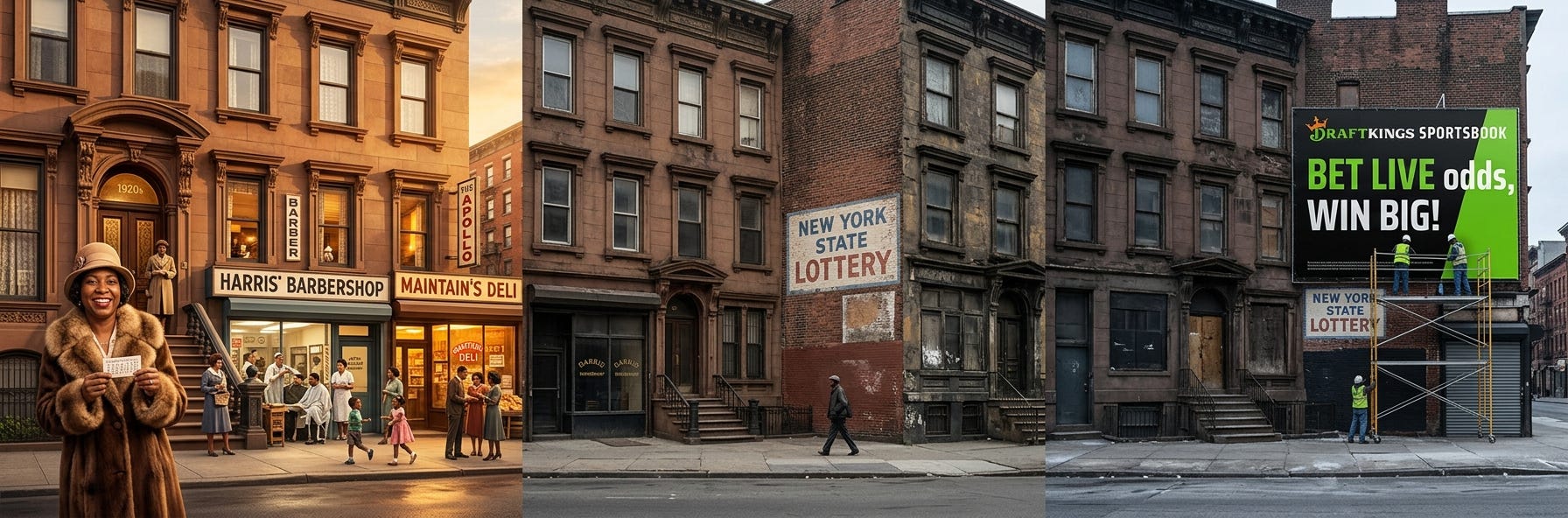
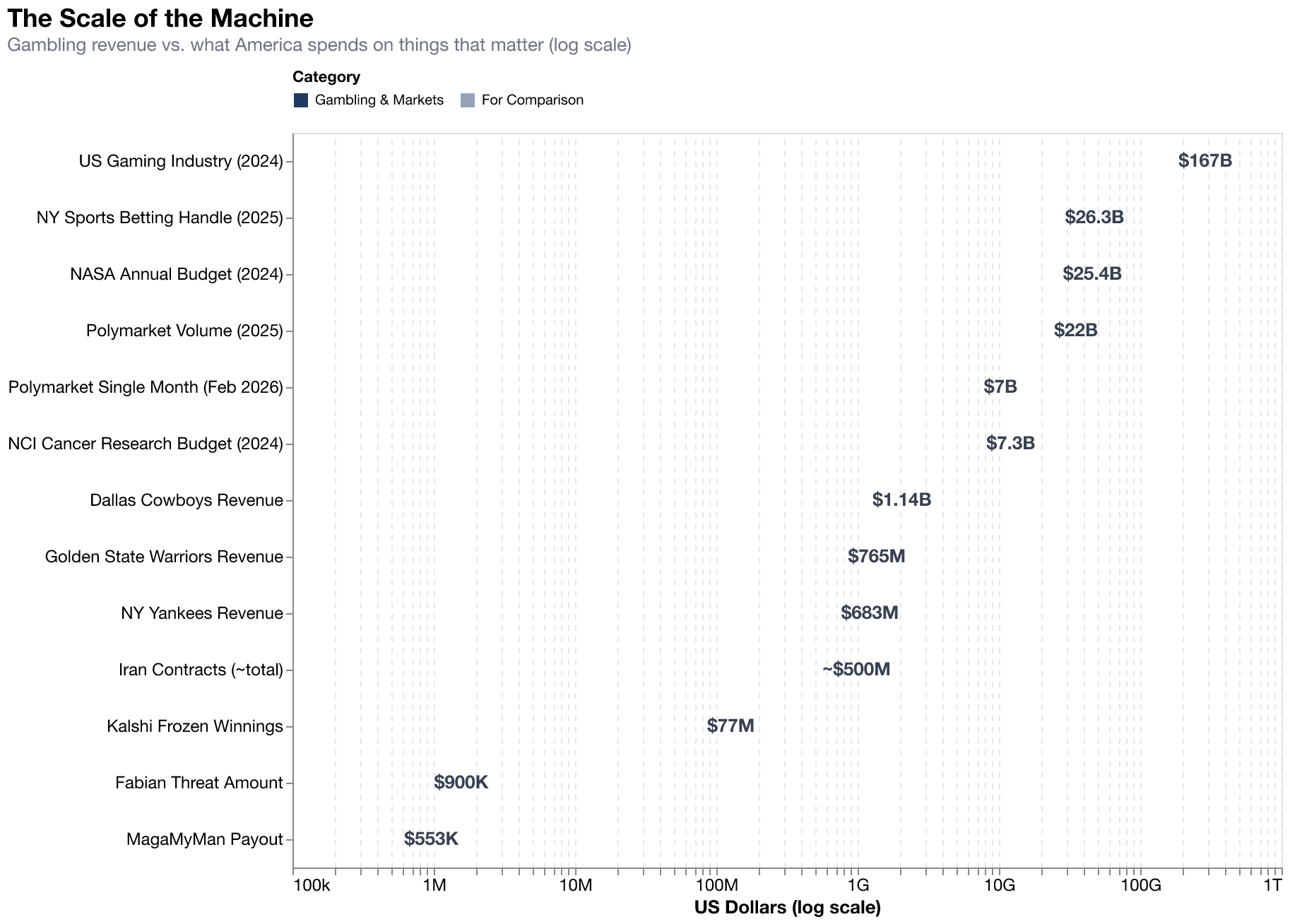
New York processed $26.3 billion dollars in legal sports betting in 2025⁴ -- same state that spent the twentieth century arresting Black men and women for running numbers in Harlem. The communities whose gambling was criminalized for generations are now the most enthusiastic participants in the legalized version -- Black Americans bet at the highest rate of any demographic⁵ -- except now the profits don't stay in the neighborhood. They flow to corporate headquarters and hedge fund dividends, to Super Bowl ads and lobbying firms. Queenie's game, stripped of everything Queenie built.
Victoria Miers saw it clearly: "The urban poor would be taxed through their gambling practices, rather than have access to profits and jobs from taxed gambling."³
Ninety-six percent of online gamblers lose money. The house always wins. But the house used to win quietly -- a numbers slip in a Harlem barbershop, a scratch-off at the bodega. Now the house wins at a hundred and sixty-seven billion dollars a year, loud enough that the customers have started to wonder whether the game they're watching is even real.⁶
II. Two-Thirds of a Country Watching a Ghost
So here we are with our gambling apparatus humming along, the ad revenue pouring in, the state legislators salivating -- and something has happened that nobody in the executive suites anticipated, or if they anticipated it they chose not to think too hard about it, which is the same thing.
The fans think it's fake.
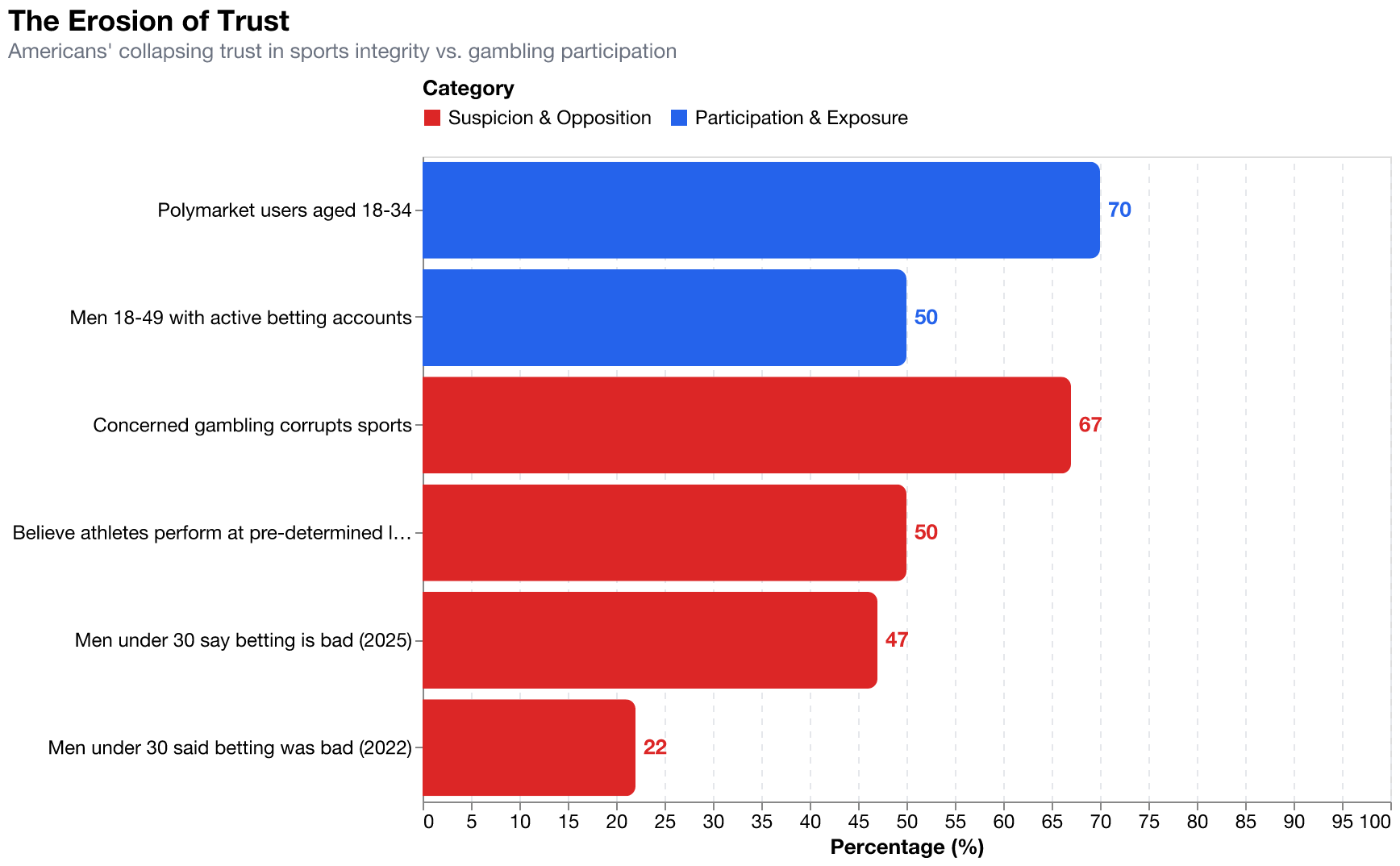
Two-thirds of Americans are concerned that gambling is corrupting professional sports. Half believe athletes perform at pre-determined levels to benefit gamblers. Two-thirds of the country, watching the product they've been sold, thinking: this is professional wrestling.⁷⁸
They're not paranoid. They're paying attention, which in America in 2026 looks identical to paranoia because the distance between what's actually happening and what sounds completely insane has collapsed to approximately zero.
October 2025: the FBI arrested thirty-four people in a rigged sports betting ring tied to the NBA. A Hall of Famer. A head coach. A current player on the Miami Heat. And the FBI linked the operation to La Cosa Nostra -- the same organized crime families that took over the Harlem numbers racket from Black operators eighty years ago. The mob never left gambling. Gambling came back to the mob. A goddamn ouroboros with a betting slip in its mouth.⁹¹⁰
A month later: two Cleveland Guardians pitchers -- Emmanuel Clase and Luis Ortiz -- were federally indicted for rigging individual pitches. Not games. Pitches. Clase took bribes to throw balls in the dirt, manipulating prop bets that didn't exist before 2018 because the micro-betting markets that created demand for them didn't exist before 2018. He faces sixty-five years in prison, which is roughly sixty-five years more than any DraftKings executive will ever face for building the system that made the bribery profitable.¹¹¹²
Same week: the FBI met with the UFC about an allegedly rigged fight. The NCAA accused six former players of gambling schemes across seventeen Division I programs.¹³
I was reading these things one after another, each one worse than the last, and the thought that kept forming -- the one I kept pushing down because it sounded like something a conspiracy theorist mutters right before you stop inviting him to dinner -- was: this is what the system produces. This is not dysfunction. This is function.
The leagues opened gambling's gates because cord-cutting was eating their revenues. More bets, more eyeballs, more engagement -- that was the theory. And it worked, the way a monkey's paw works. The wish was granted. The gambling money poured in. But a suspicious audience doesn't watch with more intensity. It watches with less. And if the suspicion keeps building -- if the indictments keep landing, if the pitch-rigging keeps surfacing -- the product rots from the inside while the gambling checks are still clearing.
The gamblers haven't disappeared, though. They've migrated. Because when the sports casino starts to stink, the rational move is to find one that doesn't.
III. Every Difference of Opinion Is a Tradable Asset
Tarek Monsour, the CEO of Kalshi -- the CFTC-regulated prediction market that lets you bet on Federal Reserve decisions, election outcomes, and whether a given country will be invaded this quarter -- said something in an interview that lodged itself in my skull like a splinter with a business plan.
He said: "There's a little bit of a feeling generally that overall the game is rigged against people."¹⁴
He said this while pitching his platform as the antidote. The level playing field. The place where the Kansas farmer can beat Goldman Sachs because everyone has the same information and the same odds and the market rewards wisdom over connections.
"The game is rigged against people," said the man building a new game.
And the pitch works because the diagnosis is correct. The game is rigged. What the interface is specifically designed to prevent you from asking is whether this new game's rigging just looks cleaner -- better code, nicer font, same house edge.
And for a while the pitch was seductive. The democratization of information. The regular guy beating Wall Street on pure knowledge. It works especially well on the exact demographic it needs to work on: young, male, digitally native, economically screwed. The kids who've been burned by every other system that promised fairness.
Seventy percent of Polymarket users are between eighteen and thirty-four. Half of all men between eighteen and forty-nine have an active sports betting account.¹⁵ Paul Kedrosky called it a virus.³⁴
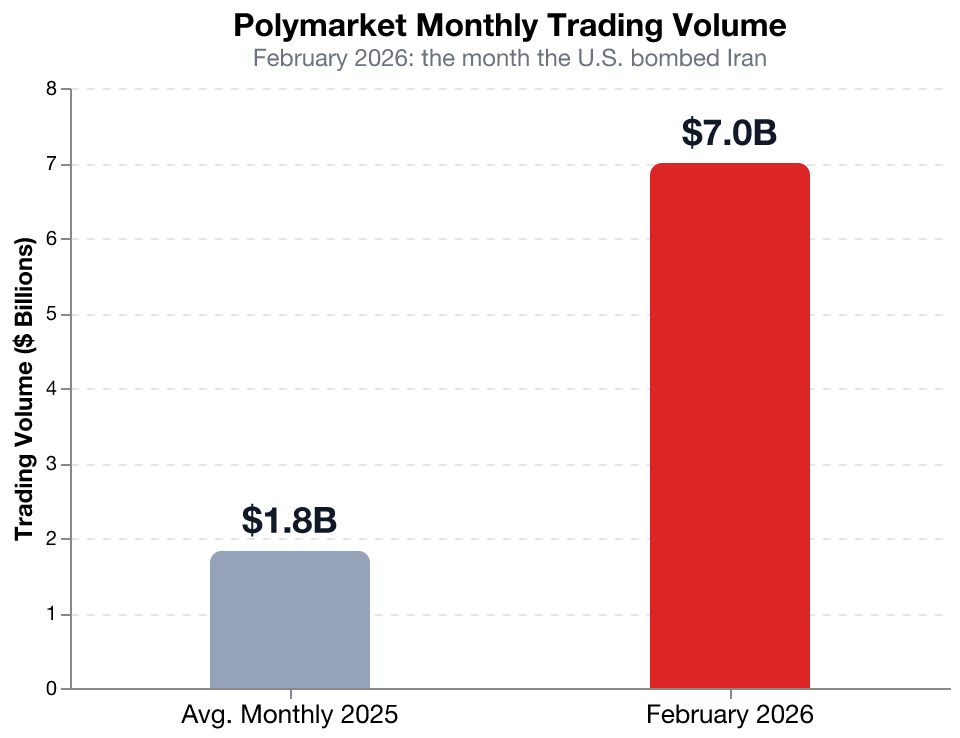
Polymarket processed $22 billion in trading volume in 2025. Hit $7 billion in a single month. February 2026. The month the United States bombed Iran.¹⁶
Because the prediction markets don't just let you bet on interest rates. They let you bet on wars. On assassinations. On famine. On whether a nuclear weapon will be detonated this calendar year. On how many people will be deported. On whether a journalist will be killed.
Every difference of opinion is a tradable asset.
I told you about the eleven-cent Iran contract. What I didn't tell you is that I opened the app again the next morning -- not to buy, just to watch the numbers move. The interface was still clean. The odds were still updating in real time. And the forty-five seconds of knowing I'd felt the night before was still in my chest like something swallowed that hadn't dissolved.
Michael Sandel saw this decades before any of us had the language for it: when you put a price on whether a country gets bombed, you don't just predict the bombing. You do something to the bombing. You change what it means. You turn it from an act of war into a line on a balance sheet, from a moral event into a market event, from something that demands the full weight of human conscience into something that can be won or lost, hedged or doubled down on.¹⁷
Markets don't just move goods around -- they change what the goods mean. Pay a kid to read a book and he'll read the book, but you've taught him that reading is labor. Hire a mercenary to fight your war and your citizens survive, but you've gutted the idea of citizenship. Sandel saw all of it, and nobody listened, because nobody ever listens to the philosopher until the thing he warned about is already eating people.
Letting half a billion dollars slosh through contracts on whether Iran gets bombed doesn't just aggregate predictions about the bombing. It creates a financial constituency that profits from the bombing happening. It makes the bombing a product. It creates demand.¹⁸
Kalshi froze $77 million in winnings on a market predicting Khamenei's ouster -- retroactively citing a policy against bets "directly tied to death" -- but only after Khamenei was confirmed killed in the strikes. They profited from the trading fees on every bet about regime change, then discovered their moral principles the moment the death was confirmed. Polymarket archived its nuclear-detonation markets, but only after those contracts had attracted hundreds of thousands of dollars.¹⁹
The conscience arrives after the check clears. This is not new. This is America's oldest financial tradition.
IV. The Government Knew
Let me tell you a story about a thing the government built and then destroyed and then watched the private sector rebuild without lifting a finger -- because this is what governments do in this country: they identify the poison, label the bottle, and hand it to the first entrepreneur who promises to make the poison profitable.
Four months before September 11th, 2001, DARPA launched something called the Policy Analysis Market. FutureMAP. The idea was elegant and insane in the specific way that only government ideas can be: use prediction markets to forecast geopolitical events, including terrorist attacks. Let analysts bet real money on coups, assassinations, bombings. The theory was sound -- markets aggregate information better than intelligence agencies, financial incentive forces honest assessment -- and the moral hazard was so obvious that a child could have spotted it. If you can profit from predicting terrorism, you can profit from committing terrorism.²⁰
Congress killed it in 2003. Two senators held a press conference and called it "a federal betting parlor on atrocities and terrorism." Dead. Done. Buried.
In 2003, you needed a security clearance and a desktop terminal to play this game. In 2026, you need a phone and a thumb. In 2028 you probably won't need the thumb -- they'll figure out how to let you lose money by blinking at the screen, and the blink will count as informed consent.
The private sector dug up the corpse and put a suit on it. Polymarket, Kalshi, Manifold Markets, and a dozen others. No clearances. No intelligence oversight. No insider trading enforcement worth the name. And the government -- the same government that killed FutureMAP because the moral hazard was too obscene to contemplate -- watched. Did nothing. The poison, relabeled and privatized, back on the shelf with a venture capital valuation.
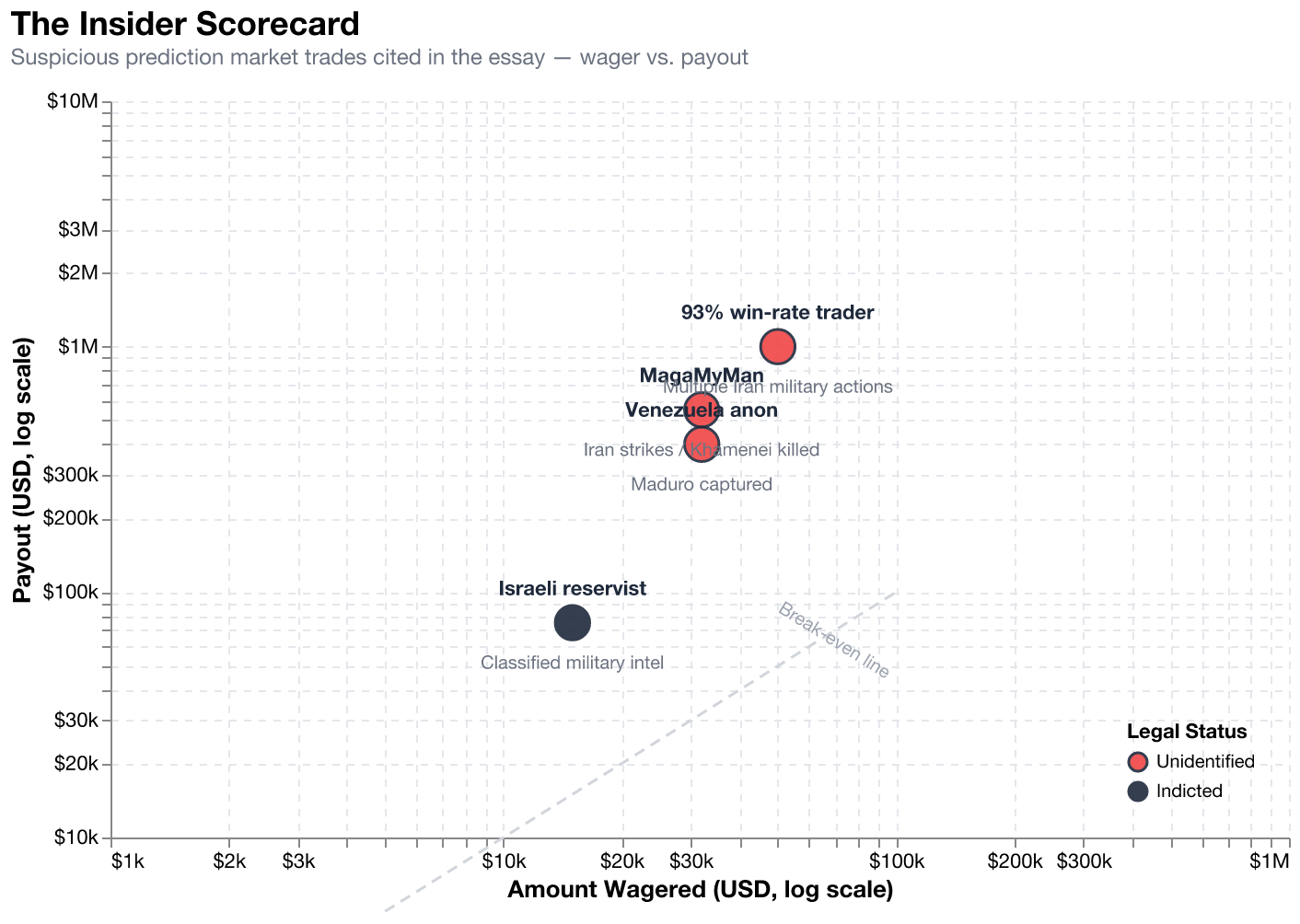
A single trader on Polymarket has won 93 percent of five-figure wagers on U.S. and Israeli military actions against Iran since 2024. Ninety-three percent. On predicting unannounced military operations. Nobody knows this person's name. They exist as a string of characters on a blockchain, and they have correctly predicted the timing of secret military strikes dozens of times, and they have collected nearly a million dollars.²¹ I keep staring at that number the same way you stare at a wound that hasn't started hurting yet -- waiting for it to mean something other than what it obviously means.
A user called MagaMyMan placed $32,000 on the United States bombing Iran on a specific date. Odds: seventeen percent. Hours later, strikes began that killed Iran's supreme leader. Payout: $553,000.²² An anonymous user created a brand-new Polymarket account in December, bet only on Venezuela, staked $32,000, and netted over $400,000 in twenty-four hours when Maduro was captured.²³²⁴ An Israeli military reservist has been indicted for using classified material to trade on Polymarket -- the first prosecution worldwide for weaponizing military intelligence on a prediction market.
Dick Costolo -- former CEO of Twitter, a man who sat at the center of the information economy for decades -- said it out loud on a podcast: if you talk to the Polymarket or Kalshi founders, "they will tell you that's part of the whole deal. Like, yeah, there's of course insider trading." PART OF THE WHOLE DEAL. Of course. Like the weather. And Kedrosky added: "There's no one regulating this."²⁵
No one.
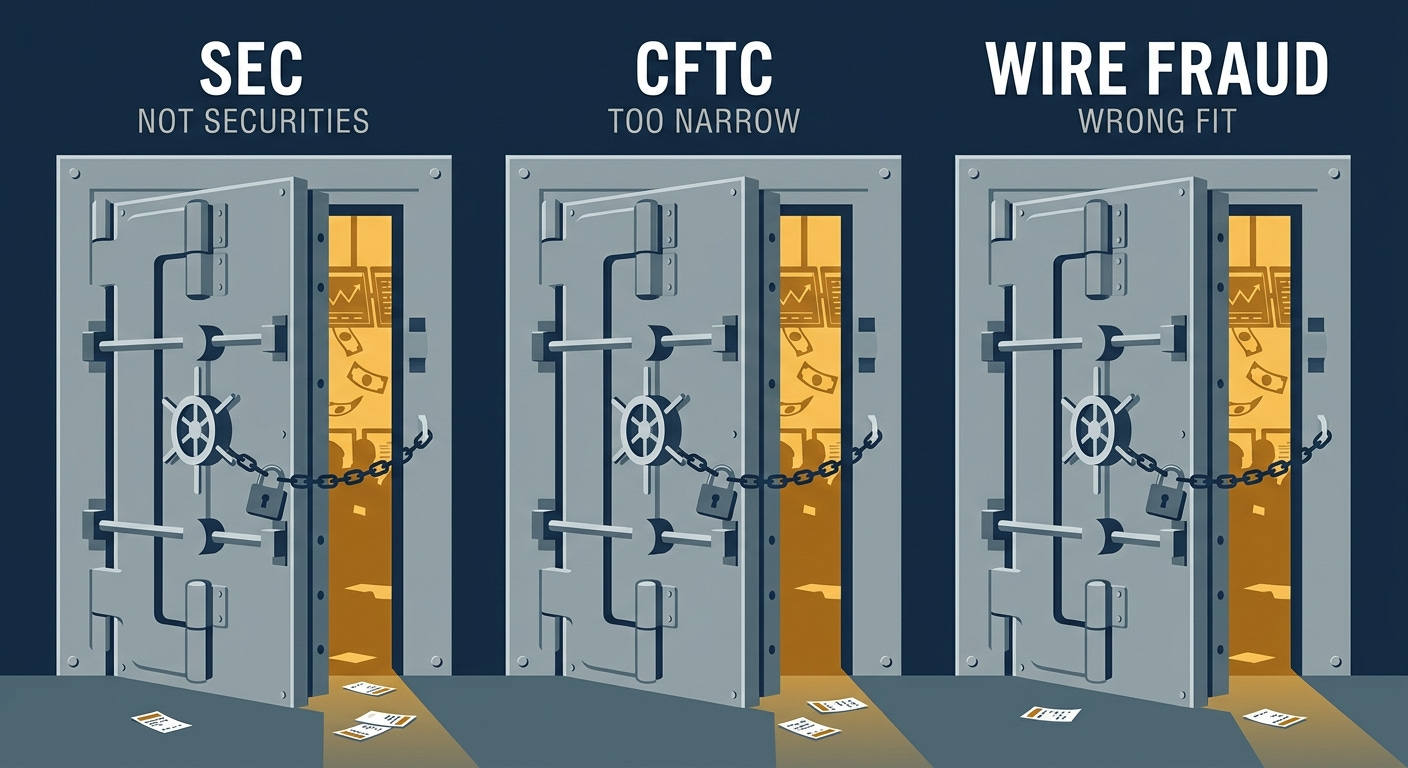
The legal architecture for stopping this does not exist. Prediction contracts are commodities, not securities -- the SEC can't touch them. The CFTC's anti-fraud rule is narrower than its securities counterpart. Wire fraud requires the information to have commercial value to the defrauded party. Three doors, all locked, and the locks were installed by people who never imagined that war would become a retail product.²⁶²⁷
September 6 and 10, 2001: a sharp uptick in put options on United Airlines and American Airlines. Twenty-five to a hundred times normal volume. Someone was betting those specific airlines' stock would crater. Days before the planes hit. The FBI and SEC investigated. Conclusion: no evidence of advance-knowledge trading.²⁹ An academic study -- peer-reviewed -- found with 99 percent probability that the American Airlines options were insider-traded.²⁸
The government said nothing to see. The academics said one-in-a-hundred chance this is legitimate.
I don't know which is true. Neither do you . . .
The institutional reflex -- look at trading anomalies that implicate national security events, declare them benign -- has been consistent for twenty-five years. The people who built the prediction markets knew this. They knew the government had killed this exact idea in 2003 and they built it anyway. They knew insider trading was "part of the whole deal." They built it anyway, pointed it at wars and assassinations and nuclear detonations, and they called it innovation, and they called it price discovery, and they called it the democratization of information, and they collected their fees while half a billion dollars moved through contracts whose resolution required human beings to die.
V. The Good Idea
But.
But.
The prediction market works. It really does produce better forecasts than panels, agencies, and pundits. Polymarket called the 2024 election more accurately than the aggregates.³⁰ The Kansas inflation forecaster who outperformed the Fed's own models on Kalshi -- he's real. His existence is not a marketing fiction. The idea that every person's informed opinion backed by their own money can compete with institutional expertise -- that idea is not a hustle. It's the best version of the thing.
And the young men flocking to these platforms are responding to a legitimate grievance. The game IS rigged against them. The stock market IS tilted toward institutional investors with faster data, better algorithms, and the ability to front-run retail trades by nanoseconds. Student debt IS a scam. The housing market IS locked. The economy IS a machine that funnels wealth upward while telling the people at the bottom to invest in index funds and wait forty years.
The dystopia doesn't happen because bad ideas go too far. It happens because good ideas do.
The prediction market was a good idea. And it went too far the moment it moved from "what will the Fed do with interest rates?" to "when will Iran get bombed?" Went further when the thing being predicted stopped being a policy outcome and became a body count. Went off a cliff when the Kansas farmer and the Israeli military reservist found themselves on the same platform, making the same kind of bet, subject to the same rules -- which is to say no rules at all -- and the platform couldn't tell the difference between them. Didn't want to tell the difference. Because telling the difference would mean acknowledging that some information isn't just an edge. Some information is complicity.
The DEATH BETS Act.³¹ The BETS OFF Act.³² The Event Contract Enforcement Act. A parade of legislators with alarmed faces and dramatic bill names. All stalled. All going nowhere. Because the lobby has money, and the dead don't vote, and the young men losing their rent on Kalshi contracts don't organize, and the bombs are falling, and the market is pricing it all in -- the beautiful machine, working exactly as designed.
VI. The Staircase
I went looking for the economics. The addiction psychology. The regulatory failure analysis. The standard-issue autopsy kit that journalists pull out when a system is eating people.
I found terrorism studies instead.
Because of course I did. Because this is America, where every social pathology eventually reveals itself to be a radicalization pipeline if you look at it from the right angle, and the angle is always the same: a broken promise.
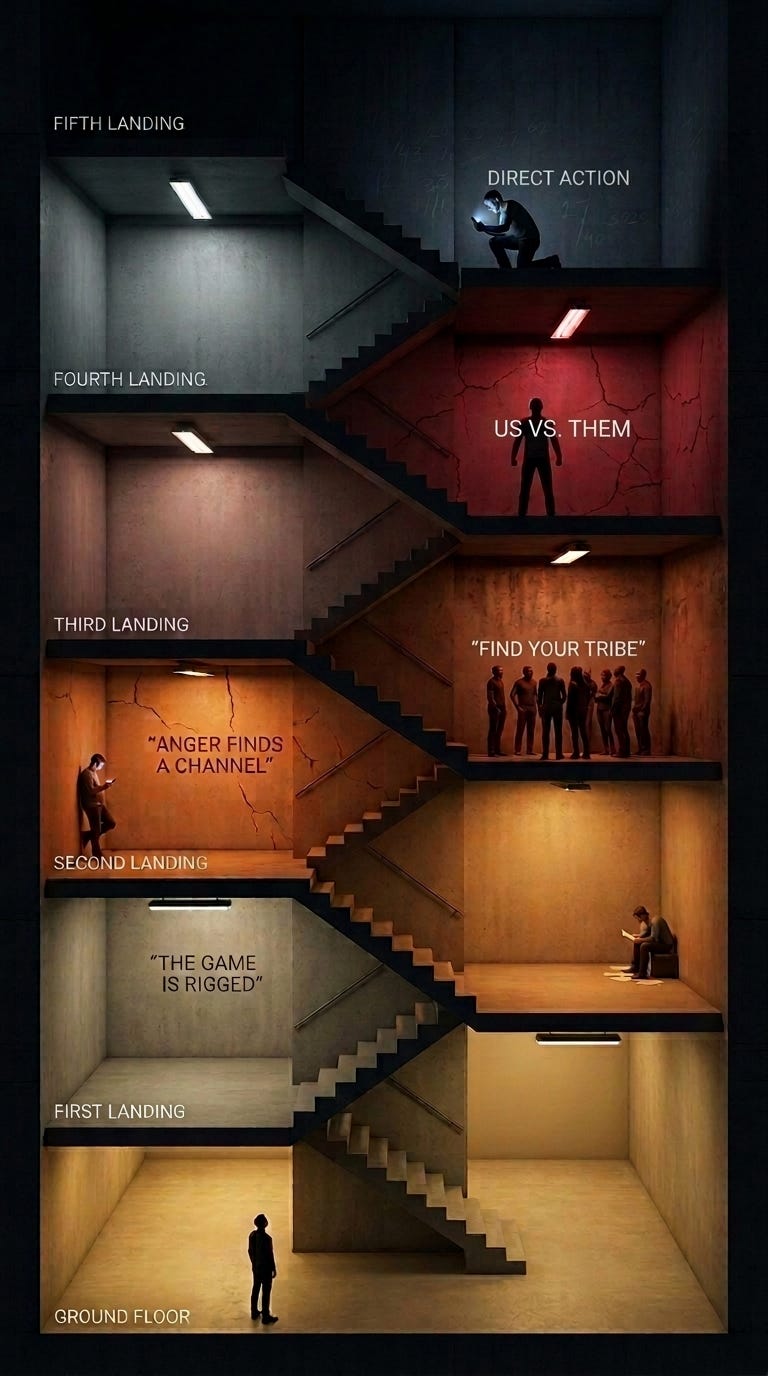
Fathali Moghaddam built a model called the staircase to terrorism. A series of landings, each one higher, each one further from the ground floor of normal life, each one closer to the roof -- where the only exit is a leap.³³
First landing: perceived injustice. The game is rigged. You can feel it before you can name it -- in the student loan statement, in the apartment you can't afford, in the algorithmic certainty that the stock market is a playground for people who are not you.
Second: displacement. The anger finds a channel. Sports betting, crypto, the kind of frantic speculative hustle that passes for financial planning when every traditional path is bricked up and barricaded.
Third: moral engagement. You find your tribe. The seventy-to-eighty percent of young male conversations that circle around prop bets and point spreads -- that's not idle chatter. That's a community. A bonded tribe of the betrayed, speaking a language of lines and odds and house edges, and the language says: you're not crazy. The game really is rigged. We all see it.
The night I bought that Polymarket contract -- the eleven-cent Iran bet -- I was on the second landing. Maybe the third. I could feel the pull of the fourth, the gravitational drag of the categorical. The part of my brain that lit up when I hit confirm was not the part that writes essays. It was the part that wanted to be inside the machine, to be the one who knew, to have the edge that made everything else irrelevant. If I'd been twenty-three and broke instead of middle-aged and employed, I don't know which landing I'd have stopped on. I'd like to think the first . . .
Fourth landing: categorical thinking. Us and them. The rigged and the riggers. The insiders and the outsiders. The person on this landing doesn't see a journalist reporting facts. He sees an obstacle between himself and the outcome the market demands. The journalist is a line item. A cost of doing business.
Fifth: direct action. The person becomes the insider -- not through the front door, the $20 million license fees and SEC exemptions took care of that -- but through the only door left.
In March 2026, a military correspondent for the Times of Israel named Emanuel Fabian reported that an Iranian missile had struck near Beit Shemesh. This was true. This was photographically documented. This was, in a saner decade, the kind of thing we used to call a fact. It contradicted the positions held by anonymous gamblers on Polymarket who had wagered more than fourteen million dollars that Iran's counterstrike would miss Israeli soil. The message arrived in Fabian's inbox on a Tuesday afternoon: "After you make us lose $900,000 we will invest no less than that to finish you."³⁵³⁶³⁷
Finish. Like a transaction. Like closing a position.
They found his home address. Referenced his parents, his siblings, the name of his neighborhood. They sent fabricated screenshots designed to make his reporting look doctored. And the language of the threats -- the part that sticks, the fossil with teeth -- was financial. They spoke of their positions and their losses and their investments in his elimination with the calm of men reviewing a quarterly earnings report. Because that is literally, precisely, what they were doing.
A man bets money on whether a country gets bombed. The country gets bombed. A journalist reports it. The gambler decides the problem is not the bombs but the journalist. The gambler decides to invest $900,000 in the journalist's elimination.
The five planes of this arc -- the hustle nationalized, the sports corrupted, the markets commodified, the insiders arrived, the journalist threatened -- map onto Moghaddam's staircase like a key into a lock. Same engine at every landing: a person promised fairness, discovering betrayal, escalating because each landing reveals a deeper betrayal than the one before.
Most don't make it to the top. Most lose their money and their interest and move on. But the ones who keep climbing aren't monsters. They're products. Products of a system that sold them a game and rigged it, then sold them a better game and rigged that too, then sold them a market and flooded it with insiders, and then -- when they tried to become insiders themselves, the only way they could -- called them criminals.
Forty-seven percent of men under thirty now say legal sports betting is bad for society -- up from twenty-two percent three years ago. The opinion shift is the most dramatic of any demographic. They can feel the teeth. They know.³⁸
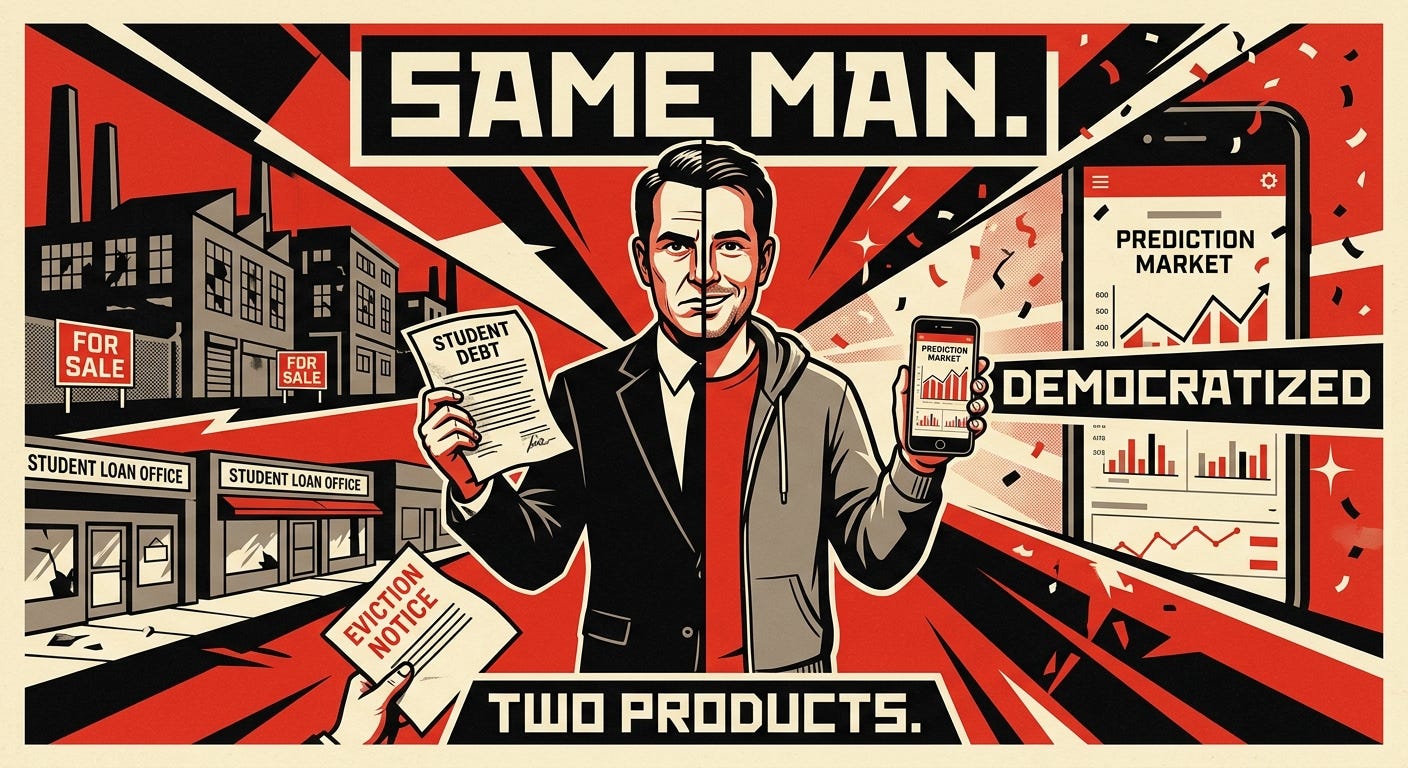
The man who sells you the despair and the man who sells you the exit are the same man. They were always the same man.
VII. The Covenant
The American Dream was always a con -- but it was a con that enough people believed in to make it function as a social contract. A covenant. Work hard, play fair, and the system rewards you. The most beautiful lie ever sold to a nation of suckers, and the most dangerous, because the people who believed it hardest were the ones who got destroyed.
Everything I've dragged you through -- from Queenie's numbers game to the death threat in Emanuel Fabian's inbox -- is the story of that covenant being shattered. In stages. Each one meaner than the last.
The state criminalizes your community's gambling, lets the mob take over, then builds its own lottery to capture the revenue. The game is honest. Fair for whom?
Sports betting goes legal. The leagues sell their integrity. Two-thirds of the country stops believing what they're watching is real. The market is fair. The FBI says otherwise.
The prediction markets arrive -- the truly level playing field -- and for about five minutes it almost works. The market is fair. The 93-percent-win-rate Iran trader says the market is a surveillance feed with a buy button.
Then the insiders. The classified intelligence already being traded. The reservist already indicted. The death threats already sent. The government that killed this exact experiment in 2003 watching it metastasize and doing nothing because the trading fees generate tax revenue and the lobbying generates campaign contributions and the moral hazard is someone else's problem until the bomb goes off.
And then the young man at the top of the staircase. The one who has been betrayed at every landing, burned by every promise, stripped of every legitimate exit. He doesn't need Andrew Tate to radicalize him -- Tate is a franchise operator, a symptom, a man who lost $800,000 on leveraged Bitcoin trades while selling financial dominance to kids who can't make rent.³⁹ The pipeline would exist without him.⁴⁰ The pipeline exists because the American Dream made a promise it couldn't keep, and the generation that discovered the lie was handed a phone app that lets them bet on the timing of their own destruction.
The twenty-three-year-old who threatens to kill a journalist to protect a $900,000 position is not a monster.
He is the product.
He is what you get when you build a civilization on a covenant and then break the covenant and then monetize the breaking and then bet on the wreckage and then threaten to kill anyone who reports on the wreckage accurately.
George Washington said gambling was the child of avarice, the brother of inequity, and the father of mischief. He said this while owning human beings whose labor he extracted through violence and whose children he sold for profit. The hypocrisy is not a footnote. The hypocrisy is the founding condition. The Dream was written by gamblers who rigged the game before the ink was dry and called the rigging a covenant.
And now the covenant is in pieces and the game is in pieces and the kids who were supposed to inherit the dream are sitting in their apartments at three in the morning placing five-figure bets on whether a bomb hits a city they couldn't find on a map, and the market is pricing it in, and the insiders are cashing out, and the journalists are getting death threats, and the legislators are naming bills after the apocalypse and letting them die in committee, and the prediction market founders are telling podcasters that insider trading is "part of the whole deal," and the whole deal -- the whole American deal, the whole rigged, broken, blood-soaked deal -- is eating itself alive on a screen you can hold in one hand.
I don't know how this ends. I know how it doesn't: with a bill, a regulation, a Senate hearing, an op-ed. Those are the responses of a system that still believes in itself, and this system stopped believing right around the time it started letting people bet on when the next bomb would fall.
Somewhere tonight, a young man is looking at a Polymarket contract and doing the math. Not the math of prediction. The math of action. The gap between what he knows and what the market knows. The gap between what he can bet on and what he can make happen.
And the market is open. And the market is always open. And the market doesn't ask where the information came from, and doesn't care where it goes, and doesn't notice when the predictor becomes the producer -- because the market was never designed to notice. The market was designed to make money. And it does. And it will . . . until somebody -- some desperate, staircase-climbing kid who read the covenant and believed it and discovered it was a lie -- decides that the cheapest way to close his position is to make the thing happen himself.
The house always wins.
Unless you burn it down.
---
Sources
1. The Gotham Center for New York City History. "The Queen of Numbers: Stephanie St. Clair and Harlem's Gambling Racket."
2. LaShawn Harris. Running the Numbers: Race, Police, and the History of Urban Gambling. University of Chicago Press. Link.
3. JSTOR Daily. "The Numbers vs. the Lottery." Victoria Miers quote on urban poor taxation through gambling.
4. SportsHandle. "Legal US Sports Betting Revenue, Handle and State Tax Database." New York $26.3 billion handle in 2025.
5. Pew Research Center. "Americans Increasingly See Legal Sports Betting as a Bad Thing for Society and Sports." October 2, 2025. Black Americans betting at the highest rate of any demographic.
6. American Gaming Association. "Commercial Gaming Revenue Tracker." $167 billion industry figure; 96% of online gamblers lose money.
7. NBC News. "Poll: Americans Fear Sports Betting Is Threatening the Integrity of Games." December 2025. Two-thirds concerned about corruption; half believe pre-determined performance.
8. Ipsos. "Rising Share of Americans Believe That Sports Betting Impacts the Integrity of Games." 2025.
9. Wikipedia. "2025 NBA Illegal Gambling Prosecution." Thirty-four arrests, La Cosa Nostra link.
10. NBC News. "26 People Charged in Connection with Alleged Basketball Game Fixing." 2025.
11. U.S. Department of Justice. "Two Current Major League Baseball Players Charged in Sports Betting and Money Laundering Scheme." November 9, 2025. Clase and Ortiz indictments, sixty-five-year maximum sentence.
12. NPR. "A Gambling Scandal Shakes Major League Baseball and Two Pitchers Are Indicted." November 10, 2025.
13. ESPN. "Scandals, Prediction Markets: Is 2025 a Turning Point for Sports Betting?" December 2025. FBI-UFC meeting, NCAA gambling schemes across seventeen Division I programs.
14. Tarek Monsour and Kalshi CEO quotes from Plain English podcast with Derek Thompson (corpus source).
15. Siena Research Institute. "22% of All Americans, Half of Men 18-49, Have Active Online Sports Betting Account." February 18, 2025.
16. QuantVPS. "Highest Volume Prediction Markets in 2026." Polymarket $22 billion in 2025, $7 billion in February 2026.
17. Michael Sandel. What Money Can't Buy: The Moral Limits of Markets. Farrar, Straus and Giroux, 2012.
18. CNBC. "Prediction Markets Face Questions on Iran War Bets." March 9, 2026. Nuclear detonation markets, half a billion in Iran contracts.
19. Fox Business. "Kalshi Sued over $54M Iran Leader Bets after 'Death Carveout'." March 10, 2026. $77 million in frozen winnings.
20. U.S. Army Military Intelligence Professional Bulletin. "The Market Knows Best: Using Data from Prediction Markets to Assess National Security Threats." Jul-Dec 2025. DARPA FutureMAP history.
21. CNN Politics. "Exclusive: Trader Made Nearly $1 Million on Polymarket with Remarkably Accurate Iran Bets." March 24, 2026. 93-percent win rate, Israeli military reservist indictment.
22. NPR. "Prediction Market Trader 'Magamyman' Made $553,000 on Death of Iran's Supreme Leader." March 1, 2026.
23. PBS NewsHour. "A $400,000 Payout after Maduro's Capture Put Prediction Markets in the Spotlight." January 5, 2026. Anonymous Venezuela trader.
24. Rep. Ritchie Torres. "Legislation to Crack Down on Insider Trading on Prediction Markets." January 2026.
25. Dick Costolo and Paul Kedrosky quotes from All-In podcast (corpus source). "Part of the whole deal" and "There's no one regulating this."
26. Harvard Law School Forum on Corporate Governance. "From Iran to Taylor Swift: Informed Trading in Prediction Markets." March 25, 2026. Legal architecture: commodities vs. securities, CFTC Rule 180.1, wire fraud limitations.
27. Congressional Research Service. "Prediction Markets and Insider Trading Law." LSB11406.
28. Allen M. Poteshman. "Unusual Option Market Activity and the Terrorist Attacks of September 11, 2001." Journal of Business, vol. 79, no. 4, 2006. JSTOR. 99-percent probability of insider trading on American Airlines options.
29. SEC. "Statement Concerning Terrorist Attack Trading Investigation." Press Release 2004-98, May 18, 2004.
30. Kotzé et al. "Prediction Markets? The Accuracy and Efficiency of $2.4 Billion in the 2024 Presidential Election." Working Paper, SocArXiv.
31. Senator Adam Schiff. "Legislation to Explicitly Ban Death and War Prediction Contracts (DEATH BETS Act)." March 11, 2026.
32. Senator Chris Murphy. "BETS OFF Act." March 17, 2026.
33. Fathali M. Moghaddam. "The Staircase to Terrorism: A Psychological Exploration." American Psychologist, vol. 60, no. 2, 2005, pp. 161-169.
34. STAT News. "Sports Gambling Is a Public Health Crisis for Young Men." November 11, 2025. Paul Kedrosky "70-80 percent" estimate; sports gambling as public health crisis.
35. Times of Israel. "Gamblers Trying to Win a Bet on Polymarket Are Vowing to Kill Me." March 16, 2026. Emanuel Fabian death threats, $14 million wagered, $900,000 threat.
36. Washington Post. "A Journalist Reported a Missile Strike. Then Came the Death Threats." March 17, 2026.
37. NPR. "People Who Had Placed Online Bets on the War Tried to Get a Reporter to Rewrite His Story." March 20, 2026.
38. Pew Research Center. "Americans Increasingly See Legal Sports Betting as a Bad Thing." October 2, 2025. 47 percent of men under 30 say legal sports betting is bad, up from 22 percent.
39. Fortune. "Andrew Tate's New Token Is a Reminder of Crypto's Bro Problem." July 16, 2024. $800,000 in leveraged Bitcoin losses.
40. The Soufan Center. "The Online Radicalization of Youth Remains a Growing Problem Worldwide." September 9, 2025.