
A Second Bill of Rights for Post-Whatever America
Diagnosing The Democratic Malfunction

Part 1 of a 3-part series: Diagnosing the democratic malfunction
I. The Paradox
The United States has the most celebrated Bill of Rights in history. And yet, multiple independent democracy researchers now classify it as an “electoral autocracy.”
The V-Dem Institute at the University of Gothenburg. The Century Foundation’s Democracy Meter. The Polity data series, maintained since 1800. These are independent sources whose professional credibility depends on accuracy, not ideology. When they converge on the same conclusion, intellectual honesty requires taking it seriously.
What went wrong?
The original Bill of Rights tells government what it cannot do. It cannot abridge speech. It cannot conduct unreasonable searches. It cannot deprive liberty without due process. These are essential protections.
But they assume that citizens, once protected from government interference, possess the capacity to exercise their freedoms meaningfully. That assumption holds only when citizens possess the material conditions for effective agency.
Housing costs now consume 47.7 percent of median income. Over 770,000 Americans are homeless—the highest figure ever recorded. Some 27.1 million remain uninsured. When you’re one medical bill away from bankruptcy, the cognitive bandwidth for political engagement shrinks to nothing.
Formal rights don’t mean much when you’re worried about where you’ll sleep tonight.
Someone saw this coming. Eighty years ago.
II. The 1944 Insight That Got Away
On January 11, 1944, Franklin Roosevelt delivered what should have been a transformative message. Speaking by radio from the White House (he was too ill to address Congress in person), he identified the fundamental problem: “Necessitous men are not free men. People who are hungry and out of a job are the stuff of which dictatorships are made.”
This wasn’t philosophy. It was observation. Roosevelt had watched European democracies collapse into fascism during the Depression. He understood something that seems obvious once stated: formal rights don’t mean much when you’re worried about survival.
He proposed a Second Bill of Rights addressing economic foundations: employment, food, housing, healthcare, education, protection against the contingencies of life. Then he died. The Cold War turned economic rights into ideological territory claimed by America’s adversaries. The proposal was never enacted. No bill was ever introduced.
Eighty years later, the philosopher John Rawls and his interpreters built elaborate theoretical frameworks to justify similar conclusions. The “veil of ignorance,” “primary goods,” “fair value of political liberties.” These concepts have their uses. But there’s a risk that the philosophical machinery obscures rather than illuminates the practical point.
The question for 2026 isn’t whether Rawls was right about hypothetical rational agents choosing principles from behind a veil. It’s whether Roosevelt’s diagnosis remains accurate. And whether changed circumstances require us to finally act on it.
III. The Numbers: Where We Actually Are
It would be convenient to dismiss concerns about American democracy as partisan hyperbole. Unfortunately, the evidence doesn’t cooperate.
The V-Dem Institute classified the United States as an “electoral autocracy” in late 2025. This is a technical classification, not a political insult. The Century Foundation’s Democracy Meter dropped from 79 to 57 in a single year, a 28 percent decline. The Polity data series now describes the United States as lying “at the cusp of autocracy.”
The domestic indicators align. Trust in the federal government stands at 9 percent among Democrats (the lowest figure ever recorded for partisans of any party) and 26 percent among Republicans. The 118th Congress enacted fewer major laws than any in the modern era. A 43-day government shutdown in 2025 became the longest in American history, despite unified party control.
The executive branch has undergone what can only be described as a concentration of authority unprecedented in peacetime. As of January 2026, over 230 executive orders had been signed; analysis indicates nearly two-thirds mirror proposals from Project 2025. Seventeen inspectors general were dismissed without the statutory notice required. Civil rights offices across federal agencies have been dismantled or sharply reduced.

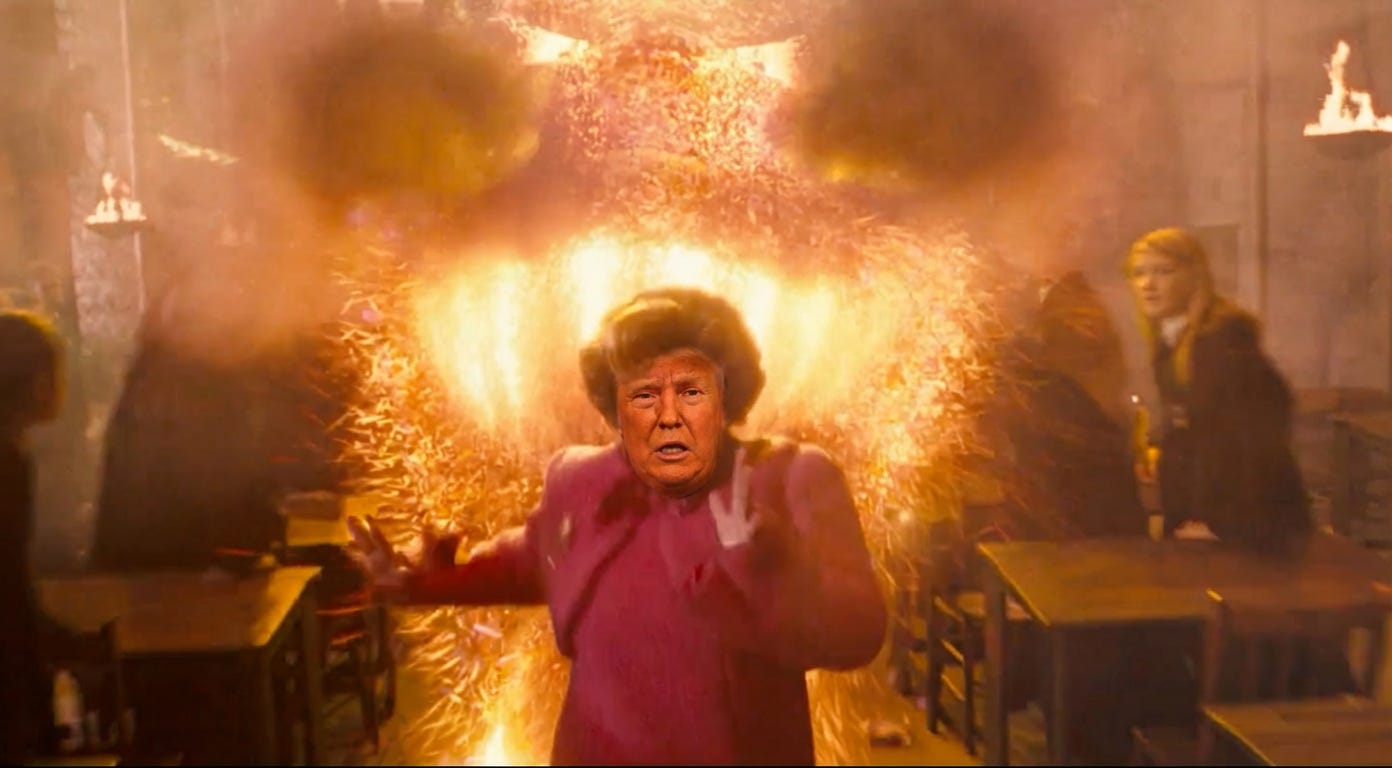
Like Filch posting Umbridge’s Educational Decrees in Harry Potter and the Order of the Phoenix, the accumulation of executive authority builds an architecture of control one proclamation at a time.
This isn’t a partisan framing. It’s institutional health metrics. Multiple independent thermometers are reading the same fever.
IV. The Veil of Ignorance: A Useful Thought Experiment or Philosophical Overcomplexification?
John Rawls’ most famous contribution to political philosophy is the “veil of ignorance,” a thought experiment from his 1971 work A Theory of Justice. The idea: imagine you’re choosing principles for society without knowing what position you’ll occupy in it. You don’t know if you’ll be rich or poor, healthy or sick, talented or ordinary. What principles would you choose?
The intuition is compelling. Behind the veil, you’d probably want a safety net. You’d want healthcare. You’d want your formal rights to actually mean something, not just exist on paper while you’re too desperate to exercise them.
This is useful pedagogy. It gets people to check their assumptions by imagining themselves in others’ circumstances. As a teaching tool, it works.
But Rawls built an elaborate philosophical architecture on this foundation, deriving “primary goods” (income, wealth, opportunities, liberties, the bases of self-respect) that rational persons would want regardless of their particular life plans. And here the critiques become relevant.
Amartya Sen pointed out that the same resources don’t translate into the same capabilities for different people. A wheelchair user and an able-bodied person with identical income have very different actual freedoms. Primary goods, Sen argued, focus on the means rather than what people can actually do with those means. The Rawlsian framework, for all its elegance, understates individual variation.
Robert Nozick questioned why hypothetical agreement should bind anyone. Real contracts bind because real people actually agreed to them. The parties in the original position are a philosopher’s construction. Why should their imagined choices constrain actual policy?
Charles Mills offered a more fundamental critique: the veil of ignorance assumes we’re starting from a blank slate, but we’re not. History happened. The “ideal theory” that imagines principles for a perfectly just society provides no guidance for a society built on historical injustice. As Mills put it, ideal theory functions as “a form of white flight” within political philosophy, retreating from the messy realities that actually need addressing.
We can hold multiple truths simultaneously (a capacity that seems to be in short supply). The veil of ignorance is a useful thought experiment for testing intuitions. It’s also philosophically contestable. And it may be entirely unnecessary for the practical argument.
You don’t need elaborate philosophical machinery to reach the conclusion that people can’t participate effectively in democracy when they’re worried about housing, healthcare, and survival. That’s an empirical observation, not a philosophical derivation. Roosevelt saw it in 1944 without citing Kant.
V. The Vicious Cycle: Why Formal Rights Aren’t Working
The Bill of Rights tells the government what it cannot do. It cannot abridge speech. It cannot conduct unreasonable searches. It cannot deprive liberty without due process. These are essential protections.
But they assume that citizens, once protected from government interference, possess the capacity to exercise their freedoms meaningfully. This assumption holds only when citizens possess the material conditions for effective agency.
Consider the numbers. Housing costs now consume 47.7 percent of median income for a median-priced home. Over 770,000 Americans are homeless—0.23 percent of the population, roughly 23 out of every 10,000 Americans—the highest figure ever recorded. This represents an 18 percent increase from 2023 alone and a 36 percent increase over the past five years. A housing deficit of 4.7 million units means that for many citizens, the preconditions for stable civic engagement simply don’t exist.
Some 27.1 million Americans remain uninsured. Thirty-six percent of adults report skipping or delaying care due to cost. When illness threatens not merely health but financial ruin, political engagement becomes a luxury.
Nearly 40 percent of fourth graders read below basic proficiency despite record per-pupil expenditures. (This tracks with my experience teaching an after-school program—students as bright as any generation, but reading well below the levels of my peers at that age, despite Chromebooks and expensive curriculum programs that seem designed to extract shareholder value without delivering proportional educational results.) The Gini coefficient measuring income inequality stands at 0.47, up from 0.43 in 1990. The ratio of wealth held by the richest families to that of middle-class families has risen from 36-to-1 in 1963 to 71-to-1 today.
Now trace the causal chain. Economic insecurity renders citizens vulnerable to institutional capture. When you’re worried about keeping your job, challenging your employer’s political preferences becomes risky. When you’re one medical bill away from bankruptcy, the cognitive bandwidth for political engagement shrinks. When education fails to provide the tools for civic participation, the capacity for informed self-governance atrophies.
Institutional capture then enables policies that deepen economic insecurity. Regulatory agencies captured not merely by the revolving door—industry veterans who happen to take government posts—but by deliberate recruitment: corporations identify, cultivate, and install personnel whose explicit purpose is to circumvent, reform, or weaponize the very regulations meant to constrain them. Tax policies that favor accumulated wealth. Healthcare systems designed around profit rather than care. Housing policies that treat shelter as an investment vehicle rather than a human need.
Deeper insecurity further weakens citizens’ capacity for political resistance. And the cycle continues.
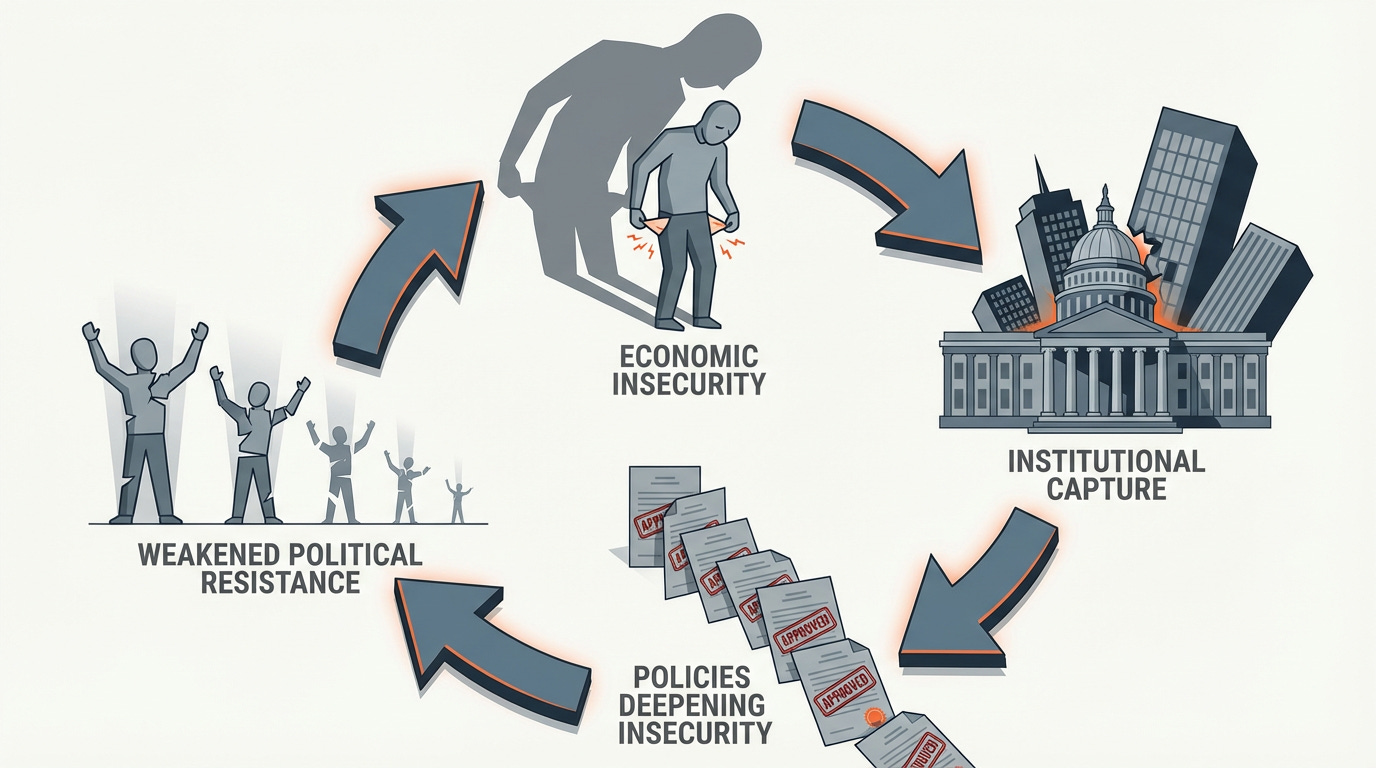
The vicious cycle: economic insecurity renders citizens vulnerable to institutional capture; capture enables policies that deepen insecurity; deeper insecurity further weakens citizens’ capacity for political resistance. Roosevelt saw it in 1944. The data confirm it in 2026. Necessitous citizens are not free citizens.
This is what Rawls meant by the distinction between formal liberty and its “fair value.” You can have the formal right to political participation while lacking the actual capacity to exercise it. The insight survives scrutiny even if the philosophical apparatus surrounding it adds complexity without proportional payoff—complexity in two senses: abstraction that requires graduate-level training to navigate, and removal from the visceral reality that the problems themselves are simple to anyone who has experienced them. You don’t need to understand the difference principle to know what it feels like to choose between medication and rent.
The original Bill of Rights, designed to protect citizens from a government that might tyrannize them, provides no remedy when the government is captured by interests that benefit from citizens’ weakness. This is a structural failure, not a contingent one.
VI. What a Second Bill of Rights Should Actually Contain
If we’re diagnosing the problem as structural, the solution must be structural too. The question isn’t what principles hypothetical rational agents would choose from behind a veil of ignorance. It’s what people actually need to participate meaningfully in democratic self-governance.
Category One: Economic Security Rights
The right to adequate housing. Not merely the absence of governmental interference with housing, but an affirmative obligation to ensure housing is available and affordable. The current deficit of 4.7 million units isn’t a market fluctuation; it’s a policy failure.
The right to healthcare. Not insurance, which remains a financial product that may or may not provide care, but care itself. A society that permits 27.1 million members to lack access to medical treatment has failed to secure a basic precondition for any life plan whatsoever.
The right to education through higher education. The transformation of education from public good to private debt (with roughly half of bachelor’s recipients carrying an average debt of approximately $29,500) represents a failure to provide the foundations for equal opportunity.
The right to a living wage. Employment that fails to provide adequate sustenance is not the exercise of freedom but its mockery.
The right to economic security against the contingencies of old age, illness, accident, and unemployment. These are not special circumstances but predictable features of human life.
Category Two: Democratic Participation Rights
The affirmative right to vote. Not merely protection from explicit prohibition, but positive guarantees of access. The enactment of at least 29 restrictive voting laws across 16 states in 2025 demonstrates that negative protections are insufficient.
The right to fair representation. Gerrymandering makes a mockery of democratic choice. When representatives choose their voters rather than voters choosing their representatives, the democratic principle is inverted.
The right to honest elections. Campaign finance systems that permit unlimited spending translate economic inequality directly into political inequality.
Category Three: Institutional Integrity Rights
The right to oversight. The dismissal of inspectors general, the defunding of accountability offices, the obstruction of inquiry: these represent attacks on the mechanisms by which citizens ensure governmental accountability.
The right to judicial independence. The Supreme Court’s legitimacy crisis (with trust at historic lows and bipartisan majorities supporting ethics reform) requires structural remedies.
The right to executive accountability. The concentration of executive power through claims of unitary authority and emergency declarations must be met with constitutional limitations explicit enough to withstand determined evasion.
These rights can be derived from Rawlsian philosophy if you want. They can also be derived more directly: this is what democratic self-governance requires to function. The philosophical route may add rigor for some audiences. For practical purposes, the functional argument suffices.
VII. The Enforcement Question: Can Positive Rights Be Real?
A predictable objection: positive rights (rights requiring governmental action rather than restraint) cannot be judicially enforced. Courts lack competence to make policy decisions about resource allocation. Such decisions are properly legislative, not judicial.
This objection mistakes a choice for a necessity.
The Constitutional Court of South Africa, in Government of the Republic of South Africa v. Grootboom (2000), established that socioeconomic rights are justiciable, capable of judicial enforcement even when such enforcement has budgetary implications. The Court developed a standard of “reasonableness”: the government must devise and implement “a coherent, coordinated program” to realize socioeconomic rights progressively. A program that “excludes a significant segment of society cannot be said to be reasonable.”
This framework preserves the separation of powers while ensuring accountability. Courts don’t dictate specific policies; they evaluate whether governmental programs meet a standard of reasonable progress toward constitutional guarantees. The legislature retains policy discretion; the judiciary ensures that discretion is exercised in good faith toward constitutional ends.
The objection “courts cannot make policy” proves upon examination to describe American practice rather than inherent limitation. Other democracies have demonstrably done what the objection claims cannot be done.
Moreover, the objection ignores the extent to which American courts already make policy. Constitutional adjudication in areas from abortion to campaign finance involves precisely the kind of value-laden decisions that the objection claims courts cannot competently make. The question isn’t whether courts will make such decisions but which decisions they will make and on what basis.
The “it can’t be done” objection fails against evidence that it has been done.
VIII. The Task Before Us
We return to the question of feasibility. Constitutional amendments require supermajorities that current polarization renders unattainable. Why propose what cannot be enacted?
This confuses two distinct questions: whether a proposal is correct, and whether it is currently achievable. The proper sequence begins with identifying what the situation requires, then proceeds to consider how those requirements might be realized given constraints. To begin with constraints is to let the current dysfunction set the terms of its own correction.
The present arrangements have demonstrated their instability. A just society, properly conceived, generates its own support: citizens who benefit from fair institutions develop allegiance to those institutions. Current arrangements have generated not allegiance but alienation. Trust levels that would have seemed inconceivable a generation ago. Institutional legitimacy in freefall. A sense among citizens across the political spectrum that the system no longer works for people like them.
This alienation creates its own destructive logic. Citizens will participate in collective systems only when they believe that participation yields better outcomes than going alone—when 1+1 at least equals 2. When that belief breaks, short-term self-interested behavior becomes individually rational even as it proves collectively catastrophic. If you believe you need to “get yours” before it all comes tumbling down, you withdraw investment from shared institutions, which accelerates their decline, which validates the belief that prompted withdrawal. The self-fulfilling prophecy of democratic collapse.
Prime Minister Mark Carney, addressing business leaders at Davos in January 2026, warned against precisely this dynamic: “A world of fortresses will be poorer, more fragile, and less sustainable. Collective investments in resilience are cheaper than everyone building their own fortresses.” The same logic applies to citizens contemplating withdrawal from collective political engagement. Capital spent securing your own fortress—whether financial, physical, or psychological—is capital not spent on the coalitions that might actually address shared problems.
The supply chain failures during COVID and the tariff disruptions of the second Trump term risk teaching exactly the wrong lesson: that we should retreat into isolationism rather than build more resilient partnerships. Risk management does not mean abandoning cooperation; it means building cooperative structures robust enough to weather uncertainty. The future is always inherently obfuscated from the present. Those who learn the wrong lessons from history are condemned to make choices that guarantee worse outcomes.
Conclusion: The System Working as Designed
The democratic decline we all bear witness to isn’t bad luck, partisan malice, or a single bad actor. It’s an inevitable consequence of how the system is designed.
A democracy that doesn’t ensure its citizens have housing, healthcare, and economic security is sawing off the branch it sits on. Citizens who are desperate can’t defend the system; they’re too busy surviving. The system undermines its own support base. We are sawing off the branch unto which we sit upon.
This is the vicious cycle: economic insecurity renders citizens vulnerable to institutional capture. Captured institutions enact policies that deepen insecurity. Deeper insecurity further weakens citizens’ capacity for political resistance. The cycle accelerates.
A constitution that protects your formal right to speak but doesn’t ensure you have stable housing, healthcare, or a living wage has given you freedom you can’t use. And a population that can’t use its freedom can’t defend its democracy.
This instability isn’t a bug. It’s a feature of constitutional arrangements that protect formal liberty while ignoring its material preconditions. The decline isn’t an accident—it’s the system working exactly as designed, just not as intended.
Roosevelt saw it in 1944. Rawls elaborated it philosophically. The data confirm it empirically. “Necessitous men are not free men..” A constitutional order that tolerates widespread economic insecurity has failed to secure the conditions for its own legitimacy. Democracies that starve their citizens of economic security don’t die of old age. They die young.
Part 2: The Reform Sequence: How do we fix a system designed to resist its own correction? - forthcoming
Part 3: Making Democracy Work Once It Exists - forthcoming
Notes
[^1]: Franklin D. Roosevelt, State of the Union Address, January 11, 1944. [FDR Presidential Library & Museum](https://www.fdrlibrary.org/sotu).
[^2]: The Second Bill of Rights was proposed as a political challenge to Congress, not as a constitutional amendment. No formal bill was ever introduced. Roosevelt died in April 1945.
[^3]: V-Dem Institute, University of Gothenburg, Sweden. Director Staffan I. Lindberg confirmed the “electoral autocracy” classification in September 2025. See [V-Dem Democracy Report 2025](https://www.v-dem.net/documents/54/v-dem_dr_2025_lowres_v1.pdf).
[^4]: The Century Foundation, [”Century’s New Democracy Meter Shows America Took an Authoritarian Turn in 2025.”](https://tcf.org/content/report/centurys-new-democracy-meter-shows-america-took-an-authoritarian-turn-in-2025/)
[^5]: Polity data series (Center for Systemic Peace), October 2025. See [Wikipedia: Democratic backsliding in the United States](https://en.wikipedia.org/wiki/Democratic_backsliding_in_the_United_States).
[^6]: Pew Research Center, [”Public Trust in Government: 1958-2025,”](https://www.pewresearch.org/politics/2025/12/04/public-trust-in-government-1958-2025/) December 4, 2025.
[^7]: Axios, [”Capitol Hill shock: The 118th Congress passed the fewest laws in decades,”](https://www.axios.com/2024/12/30/congress-118th-passed-fewest-laws) December 30, 2024.
[^8]: NPR, [”Longest government shutdown in U.S. history ends after 43 days,”](https://www.npr.org/2025/11/13/nx-s1-5606921/longest-government-shutdown-in-u-s-history-ends-after-43-days) November 13, 2025.
[^9]: [Ballotpedia, “Donald Trump’s executive orders and actions, 2025-2026”](https://ballotpedia.org/Donald_Trump’s_executive_orders_and_actions,_2025-2026); CNN and Time magazine analyses found two-thirds of early executive actions mirrored Project 2025 proposals.
[^10]: [Lawfare, “Trump Fired 17 Inspectors General—Was It Legal?”](https://www.lawfaremedia.org/article/trump-fired-17-inspectors-general-was-it-legal); Federal judge Ana C. Reyes ruled the dismissals violated the 30-day statutory notice requirement.
[^11]: The Conversation, [”12 ways the Trump administration dismantled civil rights law,”](https://theconversation.com/12-ways-the-trump-administration-dismantled-civil-rights-law-and-the-foundations-of-inclusive-democracy-in-its-first-year-273433) January 2026.
[^12]: John Rawls, *A Theory of Justice* (1971). See [Stanford Encyclopedia of Philosophy: Original Position](https://plato.stanford.edu/entries/original-position/).
[^13]: Amartya Sen, *Development as Freedom* (1999). See [Internet Encyclopedia of Philosophy: Sen’s Capability Approach](https://iep.utm.edu/sen-cap/).
[^14]: Robert Nozick, *Anarchy, State, and Utopia* (1974). See [Stanford Encyclopedia of Philosophy: Robert Nozick’s Political Philosophy](https://plato.stanford.edu/entries/nozick-political/).
[^15]: Charles Mills, *The Racial Contract* (1997) and subsequent work on ideal theory.
[^16]: [Atlanta Federal Reserve Housing Affordability Monitor](https://www.atlantafed.org/center-for-housing-and-policy/data-and-tools/home-ownership-affordability-monitor), mid-2025; Harvard Joint Center for Housing Studies, “The State of the Nation’s Housing 2025.”
[^17]: [HUD 2024 Annual Homeless Assessment Report](https://nlihc.org/resource/hud-releases-2024-annual-homeless-assessment-report): 771,480 people experiencing homelessness on a single night in 2024; represents 0.23% of U.S. population, an 18% increase from 2023, and 36% increase over five years.
[^18]: [Zillow, “US housing deficit grew to 4.7 million despite construction surge,”](https://zillow.mediaroom.com/2025-07-09-US-housing-deficit-grew-to-4-7-million-despite-construction-surge) July 2025.
[^19]: [Census Bureau, “Income, Poverty and Health Insurance Coverage in the United States: 2024”](https://www.census.gov/newsroom/press-releases/2025/income-poverty-health-insurance-coverage.html): 27.1 million uninsured in 2024.
[^20]: [Kaiser Family Foundation, “Americans’ Challenges with Health Care Costs,”](https://www.kff.org/health-costs/americans-challenges-with-health-care-costs/) updated December 2025.
[^21]: [National Assessment of Educational Progress (NAEP) 2024 Reading Results](https://www.nationsreportcard.gov/reports/reading/2024/g4_8/): 40% of fourth graders below NAEP Basic level.
[^22]: [Statista / U.S. Census Bureau](https://www.statista.com/statistics/219643/gini-coefficient-for-us-individuals-families-and-households/): Gini coefficient 0.47 in 2023, up from 0.43 in 1990.
[^23]: [Urban Institute, “Nine Charts about Wealth Inequality in America”](https://apps.urban.org/features/wealth-inequality-charts/): wealth ratio 71-to-1 in 2022, up from 36-to-1 in 1963.
[^24]: [Education Data Initiative](https://educationdata.org/average-debt-for-a-bachelors-degree): average federal student loan debt for bachelor’s degree recipients approximately $29,550; roughly half of graduates carry debt.
[^25]: [Brennan Center for Justice, “State Voting Laws Roundup: October 2025”](https://www.brennancenter.org/our-work/research-reports/state-voting-laws-roundup-october-2025): at least 16 states enacted 29 restrictive voting laws in 2025.
[^26]: [Annenberg Public Policy Center](https://www.annenbergpublicpolicycenter.org/trust-in-us-supreme-court-continues-to-sink/): trust in Supreme Court at 41%, down 27 percentage points since 2019; 75% support binding ethics code.
[^27]: [Government of the Republic of South Africa v. Grootboom](https://www.saflii.org/za/cases/ZACC/2000/19.html), Constitutional Court of South Africa, Case CCT 11/00, October 4, 2000.
[^28]: Grootboom decision establishing “reasonableness” standard for socioeconomic rights enforcement.
[^29]: Mark Carney, “Principled and Pragmatic: Canada’s Path,” address to the World Economic Forum Annual Meeting 2026, Davos, Switzerland, January 20, 2026.
Really solid framing of the vicious cycle problem. The connection between economic insecurty and weakened civic participation makes total sense when you step back and see it laid out. I've noticed this in my own community where people's politics basically become about survival mode instead of thoughtful engagement, which just feeds the whole system.